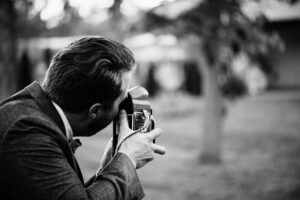

Beautiful wedding photos are the ones couples still study on anniversaries, not the ones that looked perfect in the moment.
The catch is that most albums lean too hard on posed portraits and miss the candid frames that carry real weight.
The bride who kept returning to her grandmother’s unplanned laugh, caught during a reception joke she never even heard, changed how I shoot.
1. Getting Ready Photos

The morning moves fast once hair and makeup begin, and the best getting-ready work happens in the gaps between those appointments. Bridesmaid robes and pajamas set a loose, unguarded tone that photographs softer than matching dresses ever could.
The real keeper, though, is the dress moment: whoever buttons or zips you in, mother or sister or maid of honor, that sequence is what couples ask to see first when the album comes back.
Some buttons fight back. When they do, I have asked the bride to step out, reset, and come back for a second pass so we get the real motion without the strain showing in her shoulders.
The staged version still carries the weight of the moment because the hands are the right hands.
Veil shots run the same way. Under-veil close-ups, the veil pulled forward as a soft frame, the toss with bridesmaids catching the drift: each one adds movement the formal portraits rarely achieve.
First looks with bridesmaids, caught while the bride is still adjusting an earring or laughing at a crooked hem, land harder than the posed reaction shot planned ten minutes later.
These quiet frames are the ones that outlast the ceremony in the couple’s memory, and in their requests for prints.

OUR WEDDING album by Malden holds 160 photos - 4x6

ELEGANT SILVER-PLATED COVER – Features 'Our Wedding' in classic script, interlocking wedding rings, and delicate floral corner details for a timeless display.
2. Wedding Ceremony Photos

The ceremony is where everything else on the day points toward. Start earlier than the processional; the groom waiting, the bride stepping from the car, the few seconds before anyone walks the aisle.
Those frames carry the same weight as the vows because the anticipation is the story.
Processional, first kiss, recessional. Those three are the spine most couples expect, though the recessional after everyone cheers is different from the just-married moment that follows two minutes later, when the guests are still inside and the couple finally breathes.
That second one is quieter and often more genuine.
Ceremony timing shapes color in ways couples rarely consider. A 2 p.m. ceremony in a chapel with east-facing windows throws hard sidelight and blue fill.
Move the same ceremony to 4:30 and the warm spill through those same windows turns the final images amber without any filter.
I have learned to scout the light a week ahead at the exact clock time, not midday, because the difference is not fixable in post if the couple expected golden and got flat gray.

Silky Satin: These satin kimono robes are made of silky satin fabric, super soft, lightweight and comfortable. It will feel so good against your skin

Machine wash cool, separately. Non-chlorine bleach. Tumble dry low.

Made of ultra-luxe quality silky soft SATIN fabric.Soft and light; Smooth to the touch and easy on the skin.
3. Candid Wedding Photos

The best candid shots usually happen when no one remembers the camera is there. After the service, guests relax into real congratulations instead of posed handshakes; cocktail hour laughter comes easier once the formal weight of the ceremony lifts.
These are the moments that fill albums with recognizable emotion rather than recognizable choreography.
Staying visible enough to be trusted means guests know who I am before the unscripted stuff starts. A quick introduction during the early hours, eye contact, a remembered name: that builds the permission people need to ignore me later.
The forgetting happens when I stop directing, stop moving toward the center, and let the edges of rooms become my working space.
A longer lens from ten or fifteen feet back turns observation into the method; the couples who book me for this specifically want those "in between" moments, the interactions that occur when nothing formal is scheduled at all.
Outdoor settings between service and reception help everyone loosen further. Garden light, space from the main crowd, a bride sharing a laugh with her father while the wedding party decompresses: the camera catches what posed portraits rarely replicate.
The work is in anticipating where genuine feeling will surface, then being already positioned when it does.

[Stunning Tiffany Ceiling Light] Let this great looking tiffany light fixtures ceiling decor your room! Wide 12 inch and height 2.8 inch, the perfect size makes it not too big and fit any room, it will become a gorgeous addition to home remodel.

Beautiful and Functional Piece of Decor: Cotoss Tiffany Pendant Light in 16 inches Wide lampshade by appr. 67 inches Tall totally. It comes with 60 inches long chain, the chain length can be shortened as per your need. Victorian style sea green tiffany lamp gives off a muted and relax light when lit on. It will look absolutely stunning in your room and always be a talking point for anyone visiting

Home Lighting Dimensions: Cotoss Tiffany Ceiling Lights in 16 inches Wide lampshade by 13 inches Tall, 2xE26 Medium socket and hardwired. Amber cream victorian style semi flush mount ceiling light gives off a muted and warm light, it will look absolutely stunning in your room and always be a talking point for anyone visiting
4. Bride and Groom Photos

The couple’s portrait session usually lands right after family formals, when the wedding party has already headed to cocktail hour and the pressure finally eases.
I learned the hard way that twenty to thirty minutes is the realistic window, not the hour some timelines suggest.
At one summer wedding, the ceremony ran long, the receiving line ate twelve minutes, and we had nine minutes of usable light before the shuttle left for the reception.
Midday sun is the real enemy here. Harsh overhead light carves shadows under eyes and turns foreheads into mirrors.
Open shade solves it: the north side of a building, a dense tree canopy, or the shadowed portico of the venue itself. Positioning matters too.
I keep the couple’s backs to the bright sky and drop any sky from the frame, letting the shaded area act like a giant softbox.
The light falls even across their faces, and the contrast stays manageable without heavy editing later.
When the schedule slips, the location choice becomes the save.
A short walk to a more secluded spot does two things: it buys back the intimacy that crowds steal, and it often leads to better natural shade than the obvious spot near the ceremony site.
The couple gets a breather from the day. The photos look like they had all the time in the world.

★Kit Includes:2 x Single Lamp Head (US Standard Wire 1.8m) 2 x 33 Inch White Umbrella 2 x 33 Inch Black Silver Umbrella 1 x 33 Inch Black Gold Umbrella 5 x 65w Photography Light Bulbs 3 x 1.8 * 2.8 Meters Polyster Fabrics(Black, White, Green) 6 x Fish Mouth Clip (Black) 1 x 6.5*10feet Background Frame 5 x 78 Inch Light Stand 1 x Carring Bag 3 x 5070 Single Lamp Softbox 1 x 60cm 5 in 1 Reflector Panel


Rose Gold Party Balloons: You will receive 50pcs 12 inch rose gold balloons and 1 rose gold ribbon, perfect for creating elegant and eye-catching party decorations. These metallic balloons feature a soft rose gold finish that instantly adds a stylish, festive, and luxurious touch to your celebration setup
5. Wedding Party Photos

The gap between ceremony and reception is when the wedding party loosens up, and that mood shift shows in the images.
I usually run through about eight distinct groupings in that window: the full wedding party formal, the full wedding party casual, bride with groomsmen, groom with bridesmaids, paired-off partners, bride full-length, groom full-length, and the bride and groom together at three lengths.
Albums almost always pull from the top of that list. The formal full-group shot with everyone facing camera still lands first in most layouts, and the casual version, where people actually look at each other, runs a close second.
The one pose I dropped: the staggered staircase formation. Three weddings back-to-back, and every album designer left it out.
Clients never asked for it either. It eats time to set up and the result reads as dated against the cleaner lines of a straight row or a loose cluster.
Now I skip it and spend those minutes on the casual group shot instead, which editors and couples actually use.
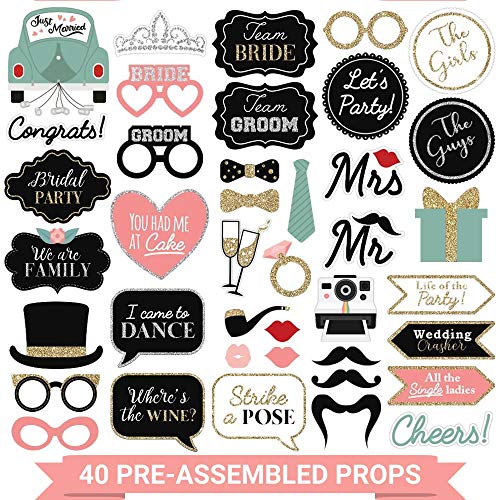
FULLY ASSEMBLED = NO WASTED TIME GLUING THEM TOGETHER 🌟 Your pink and teal wedding photo booth props will arrive to you in a sturdy box, already pre-assembled onto thick 9.5 inch wooden sticks. All you have to do is take them out of the box and you’re ready to go! We also include 40 glue dots that are optional to use in case you want to add even more support. We’ve seen many of our customers use the glue dots to add a few of the props to their walls as added party decor!

Light up bridal veils adorned with tulle bow and pearl

Package Include: 2 tier pearls wedding party bridal veil length 15.7",width 55", fit most women.
6. Dancing Photos

Reception lighting lives or dies on speed. Two AD200s on stands, usually behind me at forty-five degrees, give enough shape for movement without flattening the floor into a spotlight look.
The ceiling bounce dies around hour three once bodies pack in, so the strobes stay low and I push ISO to 3200 on a Sony body before noise starts eating the embroidery on a grandmother’s dress.
Past that, grain becomes its own subject, and not the one anybody hired me for.
The real window opens about twenty minutes into open dancing. Formalities are done, the older crowd has sat, and the remaining guests stop tracking where the camera sits.
That looseness is when the good frames happen; shoulders drop, hands go up, somebody’s tie ends up around their forehead. You feel it shift in the room before you see it through the viewfinder.
I missed it once at a barn wedding outside Asheville. Battery died at 11:17, right as the groom’s college friends started their choreographed disaster to "Mr. Brightside."
Swapped the pack in maybe ninety seconds. By then the song had peaked, the circle had formed and collapsed, and the moment I was there to catch had already become a story they told instead of a photograph they showed.
Now I run dual bodies after 10 PM, both powered, neither an excuse.

Totally 50 sheets / 100 pages, each page holds 3 horizontal photos

STYLISH DESIGN: This elegant, book bound album is an attractive way to organize and display your treasured Wedding Photos. Caption your photos with included memo writing space on every page. The front cover features a beautiful design in charcoal gray and light gray on a white background

FITS 400 WEDDING DAY PHOTOS – Large size capacity with pocket sleeves for 240 horizontal and 160 vertical photos, each page holds 3 horizontal and 2 vertical photos. 80 pages total (40 sheets).
7. Wedding Detail Photos

Flat lays work until they don’t. A ring on a white linen napkin, shot from above, turns into a pale smudge with no edge to catch the light.
The same ring on walnut veneer picks up a rim of reflected warmth and suddenly has weight. Bring a dark surface to every wedding, even the ones that promise all-white tablescapes.
Mine is a 12-inch slate board that lives in the rolling case and has saved shots of place cards, vow books, and perfume bottles that would have bled into their backgrounds.
Florals are the opposite problem. A bouquet shot straight down flattens into a disk of color; the stems, the spiral, the architecture the florist spent an hour on all disappear.
The move is to set the bouquet on its side against a clean floor or chair seat, letting the stems trail out and the blooms stack in real depth.
Light from a window, not overhead, then reads as roundness instead of pattern.
The white-dress-on-white-chair failure happened at a vineyard in 2019. The bride’s gown, hung for a detail shot, dissolved into the linen-covered vanity chair behind it.
No contrast in the folds, no shadow in the train, just a bright void. I had gaff tape and a black reflector in the car; neither was right.
Now the slate board comes, and if the dress needs hanging, I scout a dark door or a closet interior first.

Soft, Comfy, Lightweigtht and Smooth Fabric.
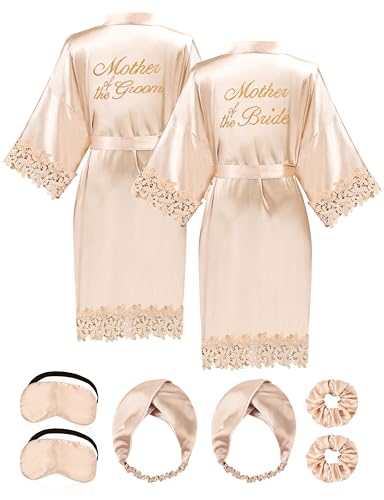
Bridal robes for bridal party: This stylish robe set includes 2 bridal party robes, 1 pcs mother of the bride robe and 1 pcs mother of the groom robe, which are gentle and eye-catching, allowing the two mothers to gracefully blend into the sweet atmosphere of the wedding and capture the warmth and beauty of their precious moments
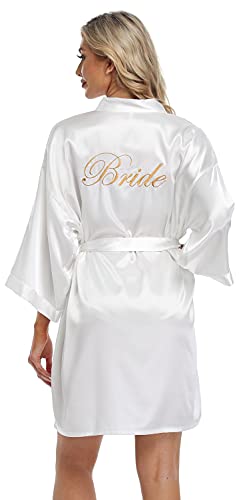
[MATERIAL]: The Bride and Bridesmaid robes are made of Ultra-Luxe And Silky-Soft satin fabric
8. Cake Cutting Photos

The cake table is usually the darkest corner of the reception room, lit by a single pin spot that flatters the frosting and nothing else.
I plant myself at a forty-five degree angle to the couple, not straight on and not behind them, so the knife catches enough light to show up in the frame and both faces stay visible.
Before anyone touches the cake, I shoot it whole: the baker spent hours on those sugar flowers, and once the knife goes in, that work is gone forever.
The couple almost always freezes when they get the knife in their hands. They look at me, they look at the camera, they wait.
That is the smile that dies on contact. What fixes it is a single sentence I give the maid of honor or best man to call out, not me: "Remember, you promised not to smash."
The couple looks at each other, somebody laughs, somebody pretends to lunge, and the reaction is real enough to shoot through.

Stained Glass Lampshade: Tiffany chandelier for living room made up of handmade stained glass lampshade and metal. The tiffany pendant light with stained glass lampshade is not only a lamp but also an art, It is an art collection that will Increase Your Home DecorationInfinite Charm

Package Dimensions: Our tea light holders are designed to fit standard tea lights, flameless tea lights, scented candles, and other similar candle types. As the holders are hand-measured, please allow for a possible tolerance of up to 1 cm. We kindly recommend checking the size carefully before placing your order.

BRASS DRUM CHANDELIER - Tiffany drum chandelier features a metal shade and stained green finish, when turn off the light, the glass shows mable green, when turn on the light, the glass turns to stunning green. This bright, hanging lamp will beautifully illuminate your home, the striking chandelier is a contemporary art piece that gives off strong modern and artistic vibes.
9. Wedding Exit Photos

Sparkler exits look effortless in the final image, but the setup eats more time than most couples schedule.
Thirty guests in the dark, each holding a lit tube of burning metal, requires a coordinator with a loud voice and a plan for who stands where.
The line has to be double-file, tight enough that the couple walks through an actual tunnel of light, not a scattered arch with gaps.
The sparklers themselves are the first thing to go wrong. Cheap ones burn down in twenty seconds and throw ash that shows up as white streaks across every frame.
Longer-burning versions cost more but give you three or four passes if someone trips or the bride’s veil catches a draft.
Wind is the silent killer; even a light breeze turns those neat vertical trails into chaos that no editing fixes cleanly.
My favorite exit shot came from a night when the weather won completely. The sky opened during the sendoff, guests scrambled for cover, and the couple ran through a parking lot instead of the planned garden path.
Rain soaked everything, the sparklers fizzed out immediately, and the only light came from a streetlamp and my flash bouncing off wet asphalt.
That image, with water catching the light and both of them laughing instead of posing, hangs larger than any traditional sparkler shot in their living room. Sometimes the logistics fail and the photograph wins anyway.
10. Speeches and Toasts Photos

The good reactions during speeches never come from the speaker. Guests are already seated, plates in front of them, not doing much.
Then someone starts telling stories about the couple, and faces change fast.
I stay off to the side, not dead center. A 70–200mm stays on the camera the whole time.
That reach lets me catch the groom’s jaw tightening at a joke, the mother of the bride reaching for a napkin.
The speaker’s mouth is open, the mic is there, but the hands of the person listening tell the real story.
At one reception the father of the bride was mid-toast, saying something about his daughter at age six. I had a clean shot of his face.
But his hands were pressed flat against the lectern, spreading slightly with each pause like he was checking it was still solid. I framed for the hands, let his chin drift out of focus above them.
That image outlived every straight portrait from that night. The couple still mention it, years later.
Speeches look like they belong to the person at the microphone. The album needs what happened to everyone else while the words were in the air.

Unique Romantic Wedding-Themed Photo Props: This set includes 10pcs photo booth props with exclusive wedding-themed white roses designs, adding a romantic and fun touch to your big day. These lovely props help you capture beautiful, memorable photos with family and friends, creating lasting precious memories.

ELEGANT WEDDING FUN: Elevate your wedding festivities with our exquisite set of wedding photo booth props. These props add a touch of whimsy to your bridal shower, engagement party, or Valentine's celebration and are sure to delight guests of all ages

[ Size ] This 39-Inch Ivory Wedding Veil is Designed to Gracefully Reach Your Fingertips, Creating a Balanced and Elegant Silhouette. The 59-Inch Width Provides Beautiful Volume, Making This a Truly Classic Bridal Veil for Your Walk Down the Aisle.
Why Candid Moments Matter Most

The unposed shots carry more emotional weight five or ten years later than anything I carefully directed.
Early in my career, I leaned heavily on posed images: the bridal party lined up, the couple centered under perfect light, everyone looking at the lens. Clients were polite about them.
Then, at about the three-year mark, a bride emailed me saying she kept returning to a single frame from her reception, her grandmother laughing at a joke she hadn’t even heard, the background blurred, the composition technically imperfect.
She couldn’t stop looking at it. That feedback changed how I shoot.
Now I watch for what happens when nothing formal is scheduled. Speeches are the richest territory because guests are seated, relaxed, already emotional, and the jokes and toasts pull real reactions across the room.
A raised eyebrow between bridesmaids during a sentimental story, the way a father adjusts his glasses while his daughter speaks, these become the images couples study on anniversaries.
The trend pieces call this timeless, and the word fits, but the better description is true to who was actually there. Posed photos show who you invited.
Candid ones show what it felt like to have them.
Pre-Ceremony Through Ceremony

The thread between pre-ceremony and ceremony is light. What the getting-ready room gives me, and what it costs me, depends entirely on what happens when those doors open.
I shoot the gap hard: the bride still seated in the car, one foot on the ground, the father’s hand reaching in. These are the final seconds of one phase bleeding into the next.
The grandfather with his grandchild in pre-wedding sunshine, the groom waiting inside or out, the bride walking down the aisle, the exchange of rings, the kiss, the walk back out, the steps, the family grouping, the flower toss, the signing of the register.
If the ceremony space is window-lit and warm, I can pull the getting-ready room back from green fluorescents or tungsten orange.
If the ceremony is dim candlelight or a dark chapel, the morning footage stays where it is, color-uncorrected and flat, because I have already committed my camera to the settings the ceremony demands.
The signing matters twice: candid shots of the actual moment, then the posed pretend-signing after, when I have time to place them well.
Both go in the album, but the posed one only works if I secured the real one first.
Reception Celebration Flow

The stretch between "I now pronounce you" and the last dance is where beautiful wedding photos either pile up or fall through the cracks. Most timelines compress right here, and something has to give.
Group photos of the wedding party usually come first, while everyone is still gathered and the light holds.
An outdoor spot near the ceremony space works better than trekking across the venue; people relax faster when they do not have to hunt for it. The candid shots start once the formal groups break.
A bride sharing a laugh with her father after his speech, a guest wiping an eye during the toasts: these "in between" moments only happen when nobody is posing for them.
Speeches are prime territory for reactions, not just the speaker. I stay off to the side and catch the table watching, not the head table performing.
What I drop when the schedule shrinks: staged photo booth setups and elaborate sunset portraits with the full wedding party. Those eat twenty minutes I rarely have.
What I never skip is the quiet beat right after the ceremony exit, when the couple walks out, the guests stay inside, and they look at each other with that we actually did this expression.
No posing, no pressure, and usually the most genuine frame of the day.
Frequently Asked Questions
What are the must-have wedding photos?
Every album needs getting-ready shots, ceremony moments, candid interactions during cocktail hour, couple portraits, wedding party groupings, dancing frames, detail shots, cake cutting, the exit, and speech reactions.
The article breaks down ten specific types, from the dress moment with your mother or sister to the quiet beat right after the ceremony when the couple first looks at each other and realizes they are actually married.
How can I make my wedding photos more beautiful?
Use natural light instead of fighting it, scout your ceremony location at the exact clock time a week ahead, and prioritize candid moments over heavy posing.
Open shade solves harsh midday sun, and the real emotional weight comes from frames where guests have forgotten the camera exists.
What are some creative wedding photo ideas?
Try under-veil close-ups with the veil pulled forward as a soft frame, a bouquet shot on its side so stems trail and blooms stack in depth, or the quiet post-ceremony moment when guests stay inside and the couple finally breathes.
For cake cutting, have the best man call out "Remember, you promised not to smash" so the couple reacts to each other instead of freezing for the camera.