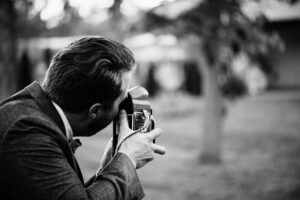
These 27 bride and groom photo ideas range from a quiet nose-to-nose close-up to a confetti drop that takes timing and a little luck, with most falling somewhere between a slow walk down the aisle and a twirl that needs a steady hand.
What decides which belongs in your album is not your budget but your willingness to move, to hold a pose through 3 counts, or to trust a child with a bubble wand.
The one constant is the photographer’s position: for the aisle exit, for the shadow length at sunset, for the moment the petals are still in the air and not yet on your shoulders.
1. The Kiss
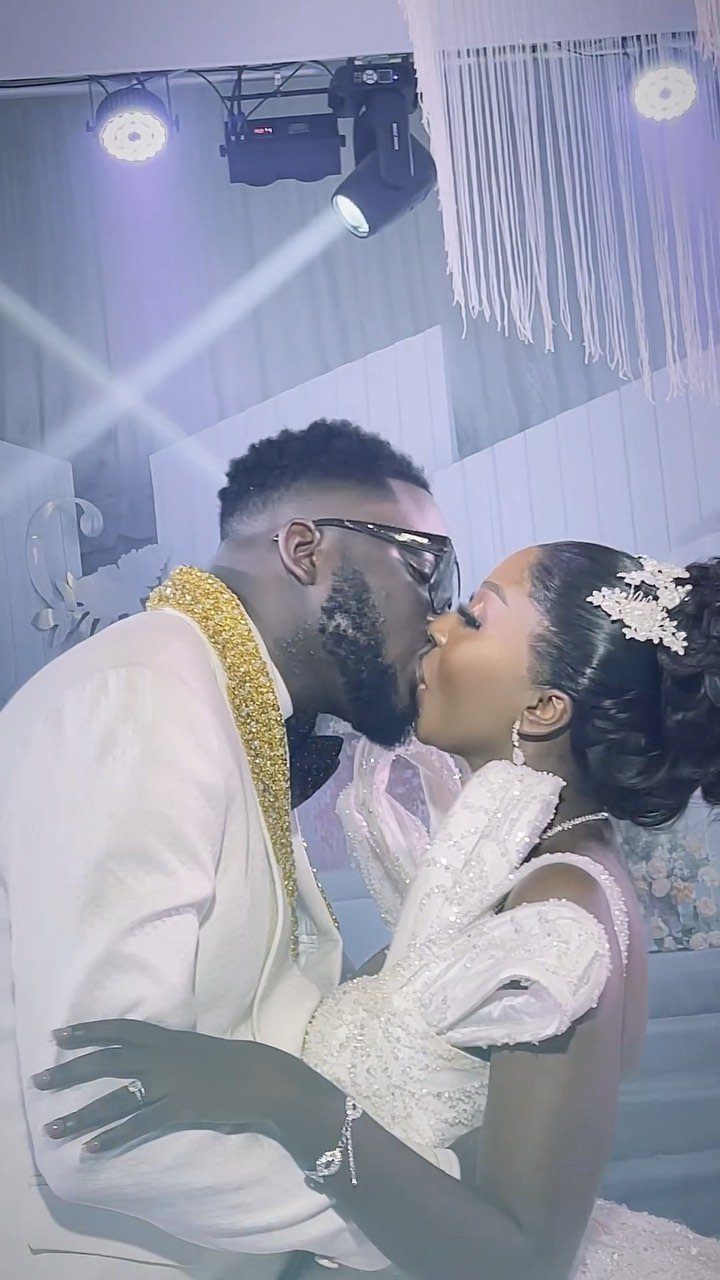
A kiss during your wedding day can range from the quick press of lips at the ceremony’s end to a staged forehead kiss that shows off both rings.
I like the forehead version for couples who want something less performative than the full romantic kiss but still unmistakably tender.
Ask your photographer to check with whoever is conducting your ceremony about stepping aside during the first kiss moment. An experienced photographer will already know to do this, but a reminder never hurts.
Hold it only briefly. The groom kissing the bride’s cheek works as a variation that reads well in photos without feeling overly posed.
2. Bridal Portraits
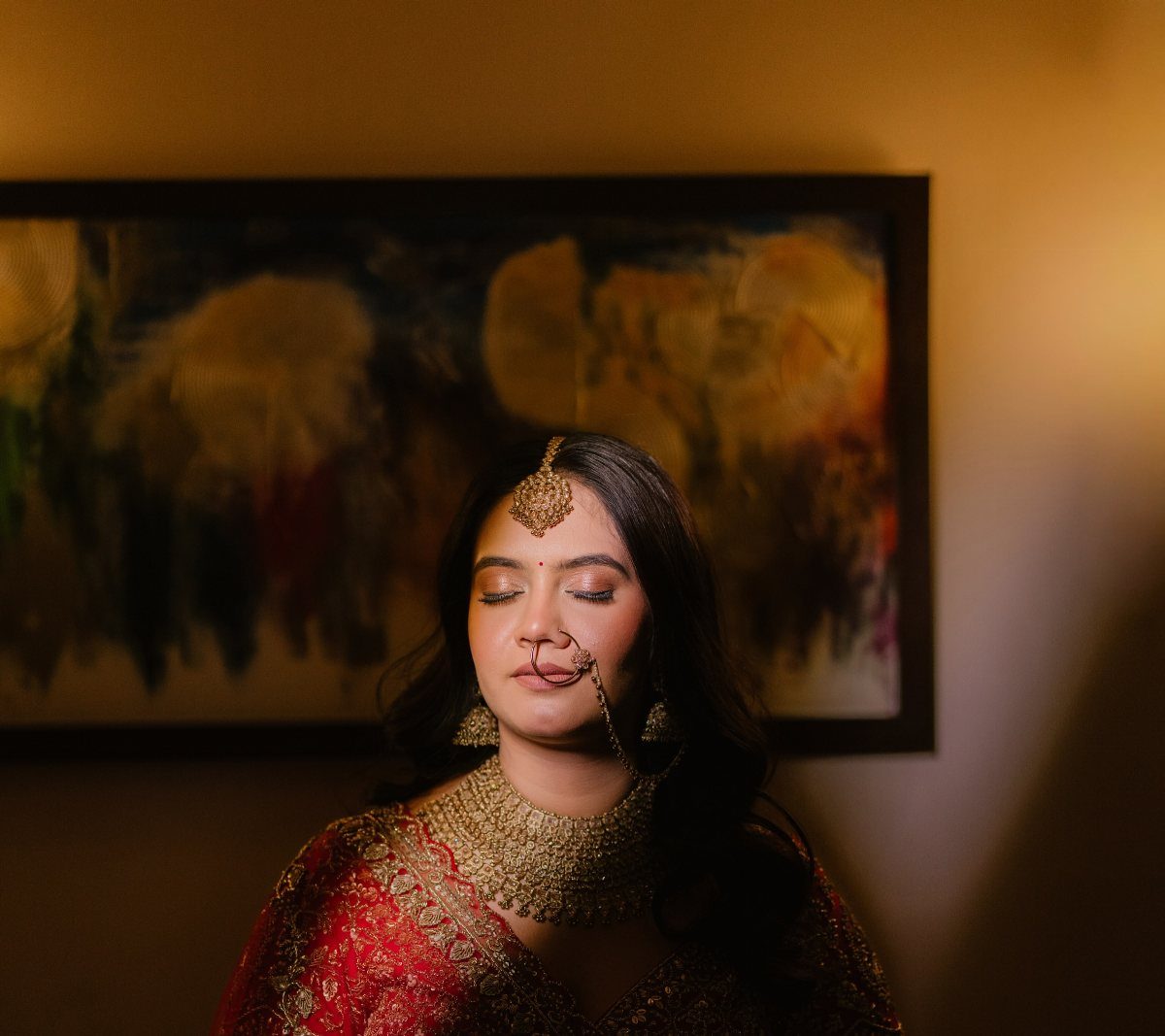
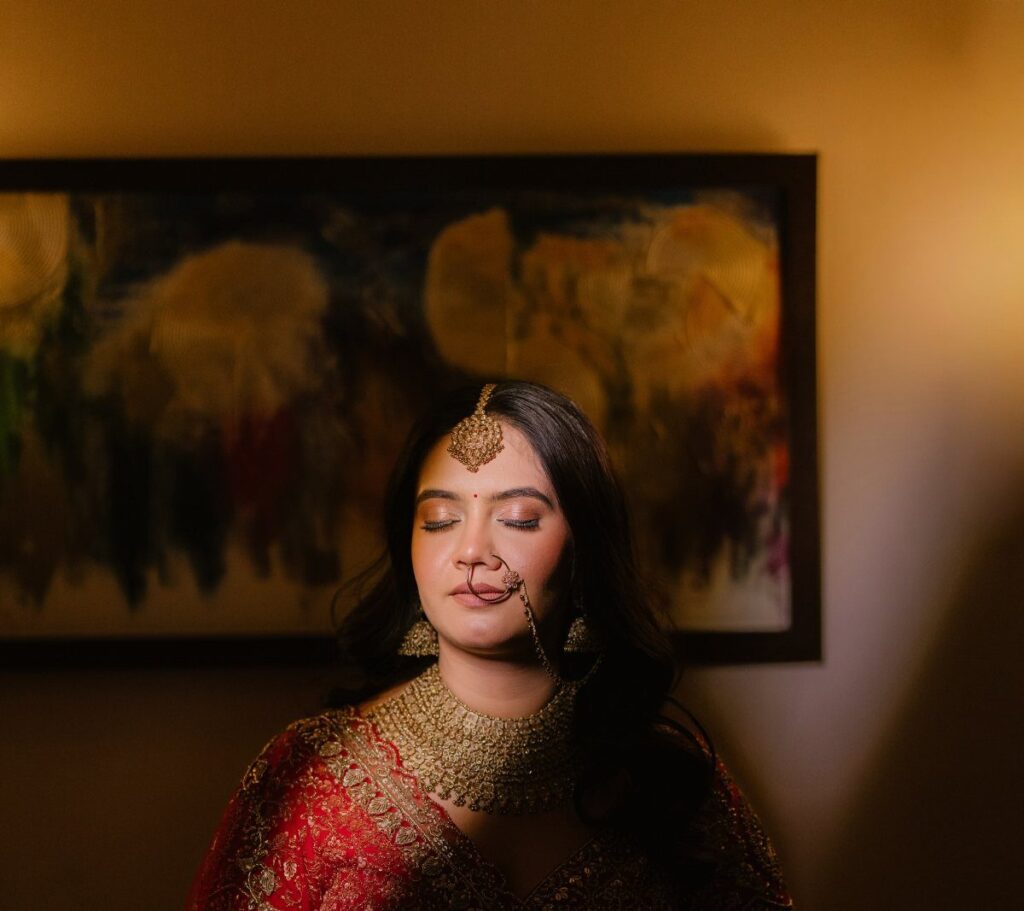
Bridal portraits give you a record of how you looked at your most prepared moment.
This can happen during getting-ready shots or a quiet moment after the ceremony rather than requiring its own session.
The best time is right after hair and makeup are complete and the dress is on, before the ceremony begins and before any nerves show.
Your spouse-to-be should get the same treatment. Standing slightly apart while holding hands, rather than pressed together, shows more personality if you are doing couple portraits alongside the solo shots.
3. Couple Holding Hands
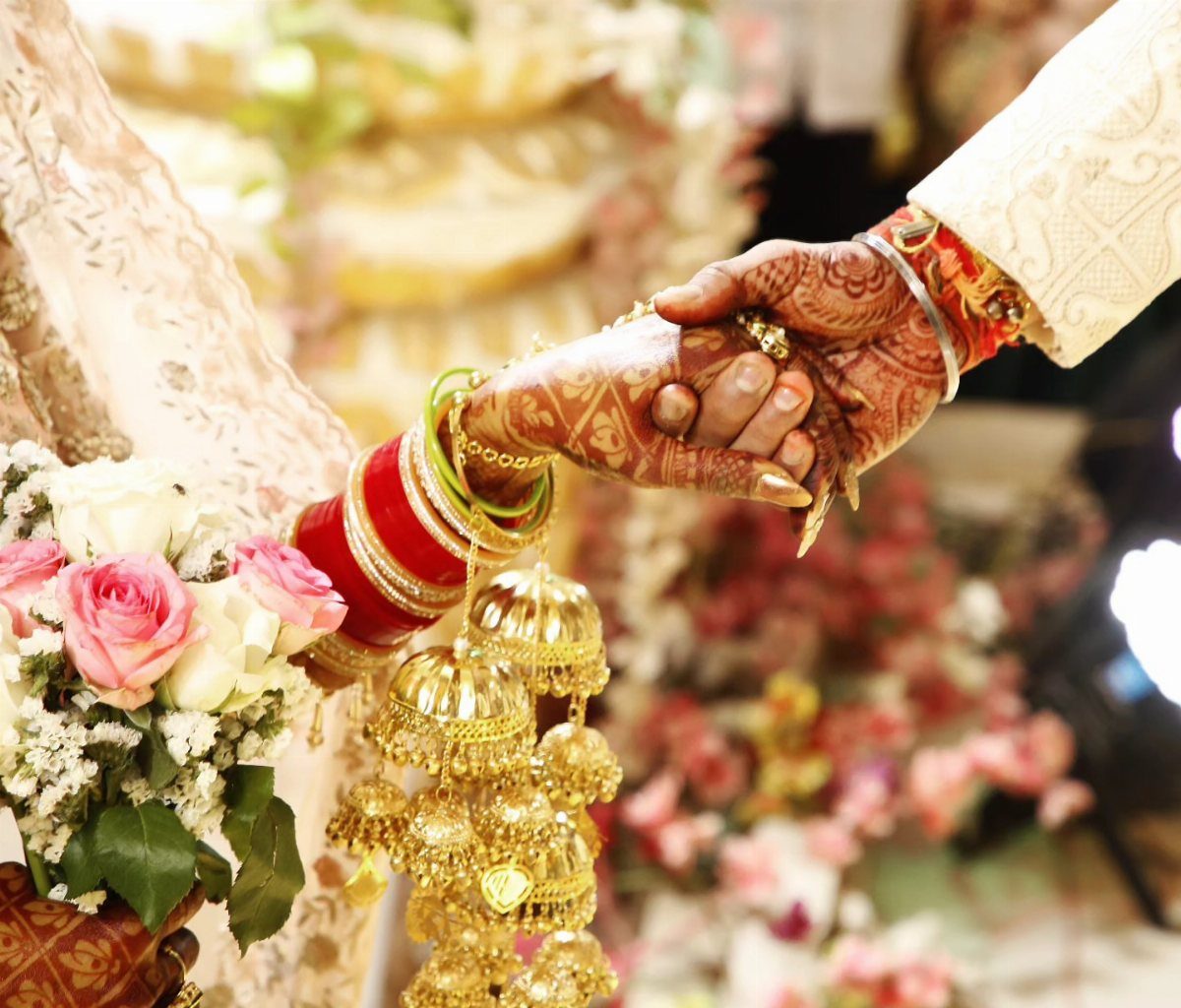
Holding hands sounds too simple to need instruction, but the spacing matters.
Most couples stand close and face the camera, which reads as stiff. A little space between you while still holding hands lets the eye travel from one personality to the other.
Henna and bangles photograph well up close, and the same pose works at waist distance or further out. A bride and groom holding hands and beginning to walk away from the camera turns a static pose into something with movement.
4. The Lift and Laugh
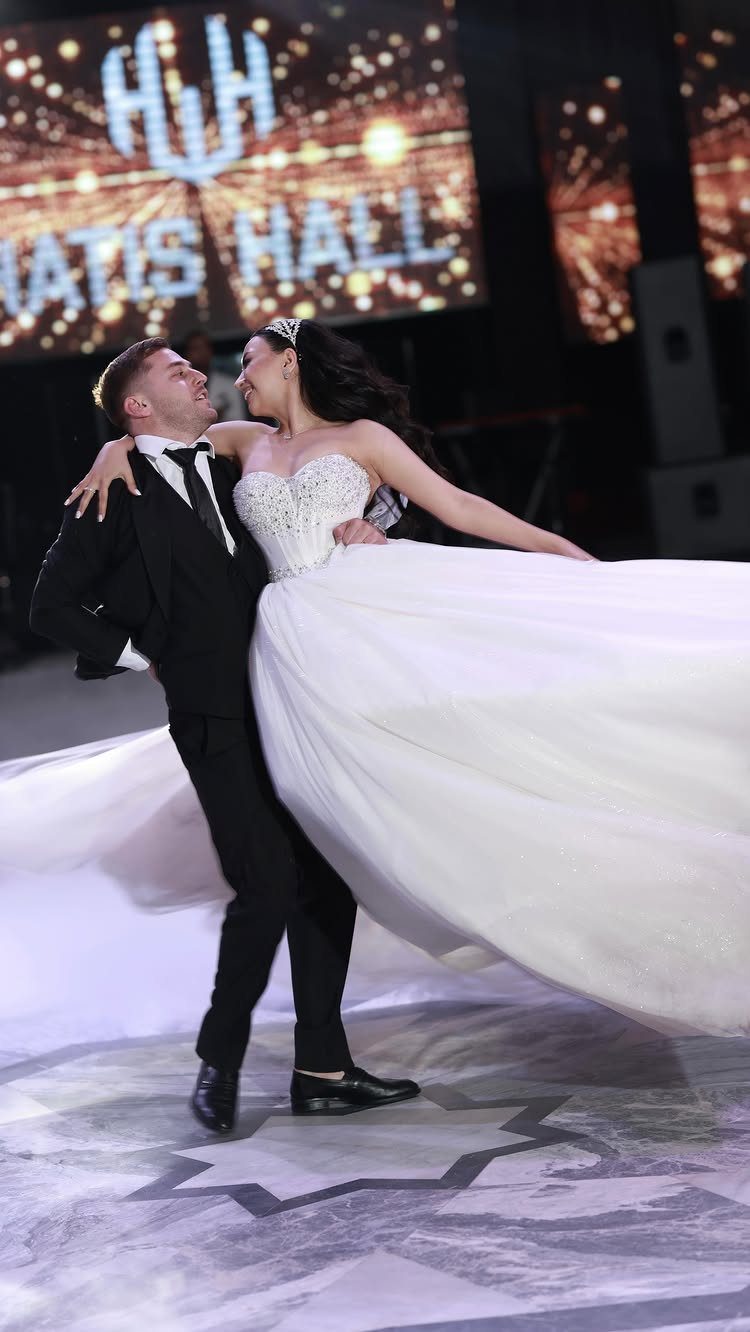
The groom lifts the bride and spins her, both of them laughing. It looks spontaneous, and the best ones nearly are, but this pose needs practice in the outfit you will actually wear.
A ballgown handles differently than jeans, and a black suit jacket limits arm movement in ways a T-shirt does not.
Practice the lift at home first. Make sure the bride is comfortable with how she will be held, and do not maintain the pose long enough for muscles to tire or smiles to strain.
Your photographer should know to capture laughter as it happens rather than forcing it.
If you want more images like this one, tell your photographer that joy and unguarded moments matter to you. Not every photographer prioritizes the same things.
5. First Dance
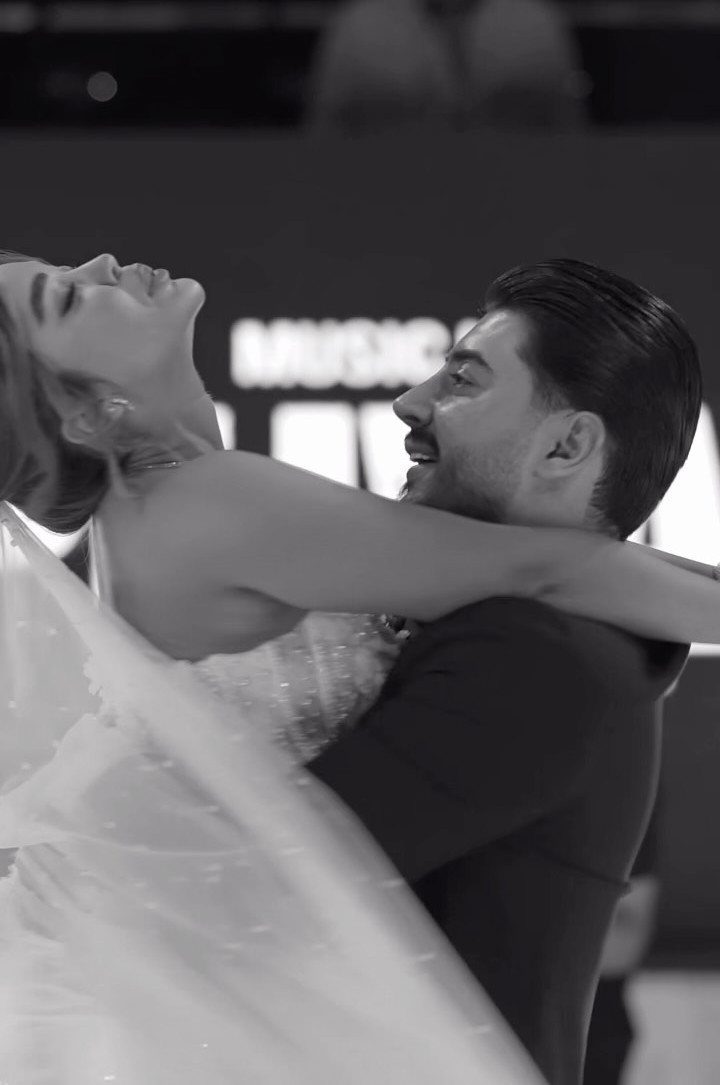
Looking into each other’s eyes rather than at your feet or over each other’s shoulders gives the photograph its center of gravity. This matters whether you have rehearsed a choreographed number or are genuinely dancing together for the first time.
Ask your photographer to stay for the parent dances too.
Those are often the images couples forget to request and later wish they had. Black-and-white handles dim reception lighting well when color would turn muddy.
6. The Smile at Camera
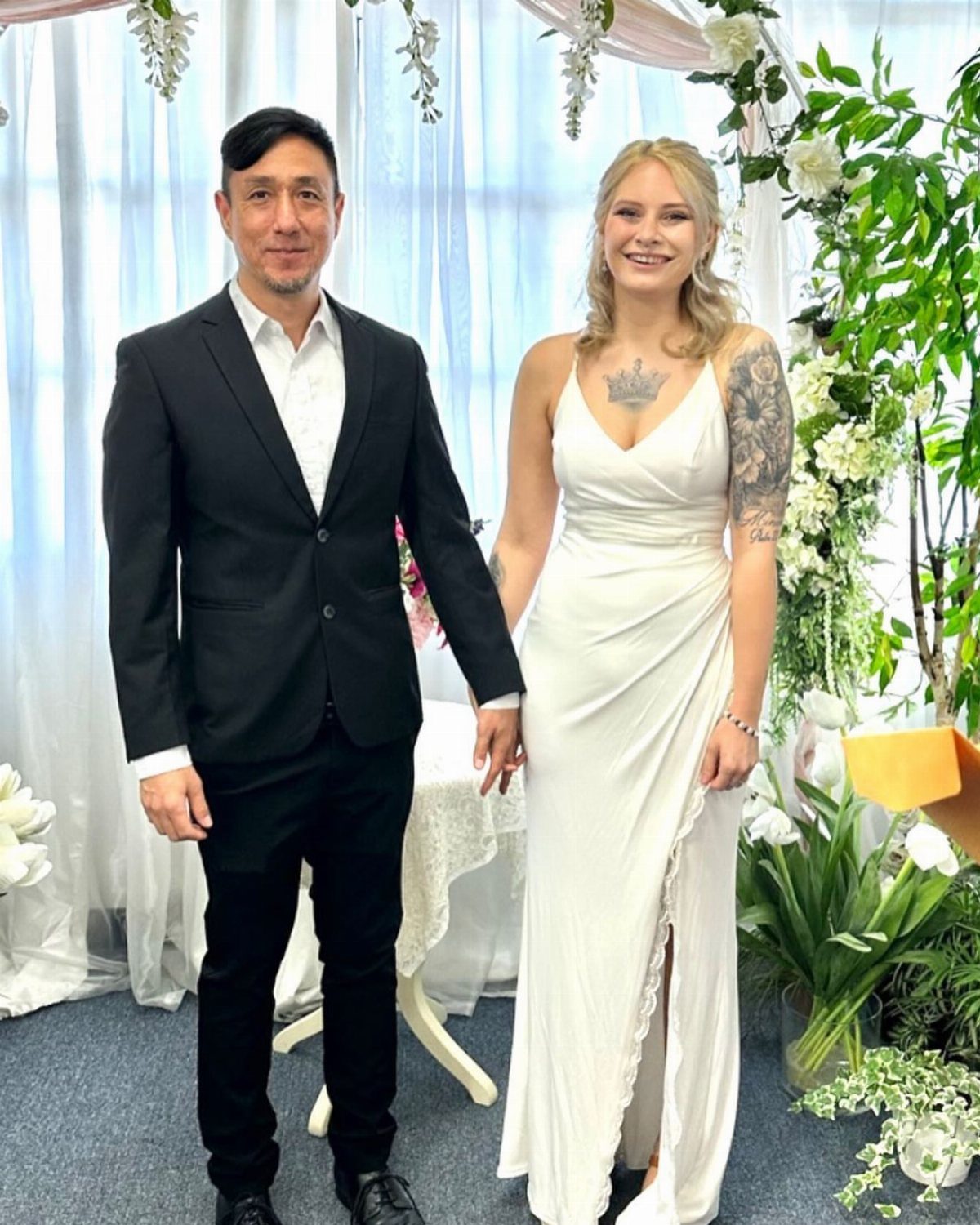
A couple smiling directly at the camera is the most traditional pose in any wedding album, and I do not use it often.
But I make sure to get at least one solid version at every wedding because some relative will want it, and because years from now it will read as the clearest record of who was there.
The smile has to reach your whole face.
Tension in the jaw or eyes will show even if the mouth is curved correctly. Think of something that genuinely makes you feel affection toward your partner, rather than performing happiness.
A broad smile gives a different mood than a slight one with just the corners of your mouth raised. Try both and let your photographer sort through them later.
7. The Walk
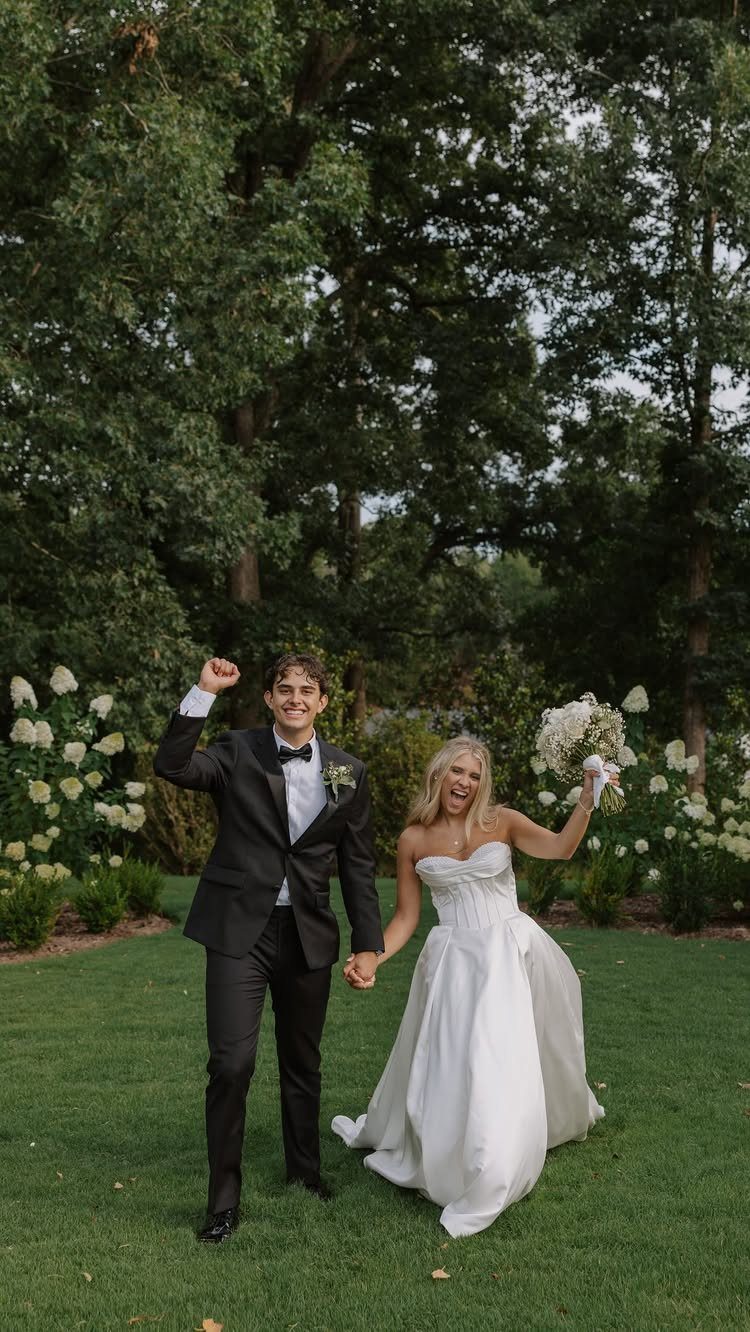
Walking toward your photographer while holding hands turns a simple path into a photograph with momentum. Raising free hands while keeping the grip between them keeps the gesture from looking rehearsed.
Tell your photographer where the walk will happen so they can position themselves ahead of you without backing into a guest or a flower bed.
A lawn gives even footing; gravel or cobblestones require shorter steps and more attention to the ground.
Joyful wedding photos often come from motion that feels natural rather than directed, so pick a path you actually want to walk rather than one that merely frames well.
8. The Dip
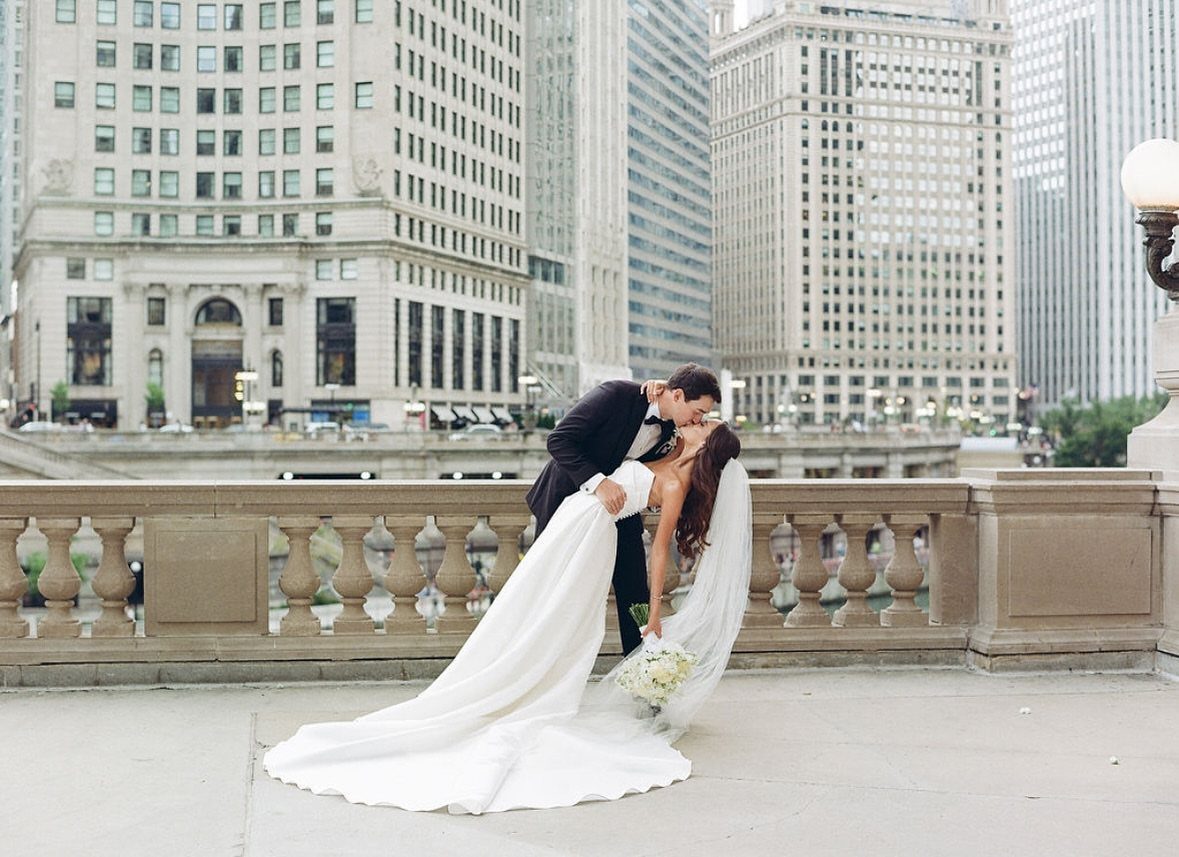
The dip works best when the groom bends at the knees rather than leaning his upper body forward, which keeps the bride secure and the line of her dress clean. Eye contact between you turns a stunt into a moment.
A city bridge with stone underfoot demands extra care: the groom should test his footing before the pose and keep the dip shallow. A beach or meadow gives softer ground and a different mood, though the mechanics stay the same.
A veil adds length and movement; a shorter dress or no veil still reads as romantic if the faces are close together. Practice once in the shoes you will wear, not barefoot.
9. Couple Surrounded with Natural Elements
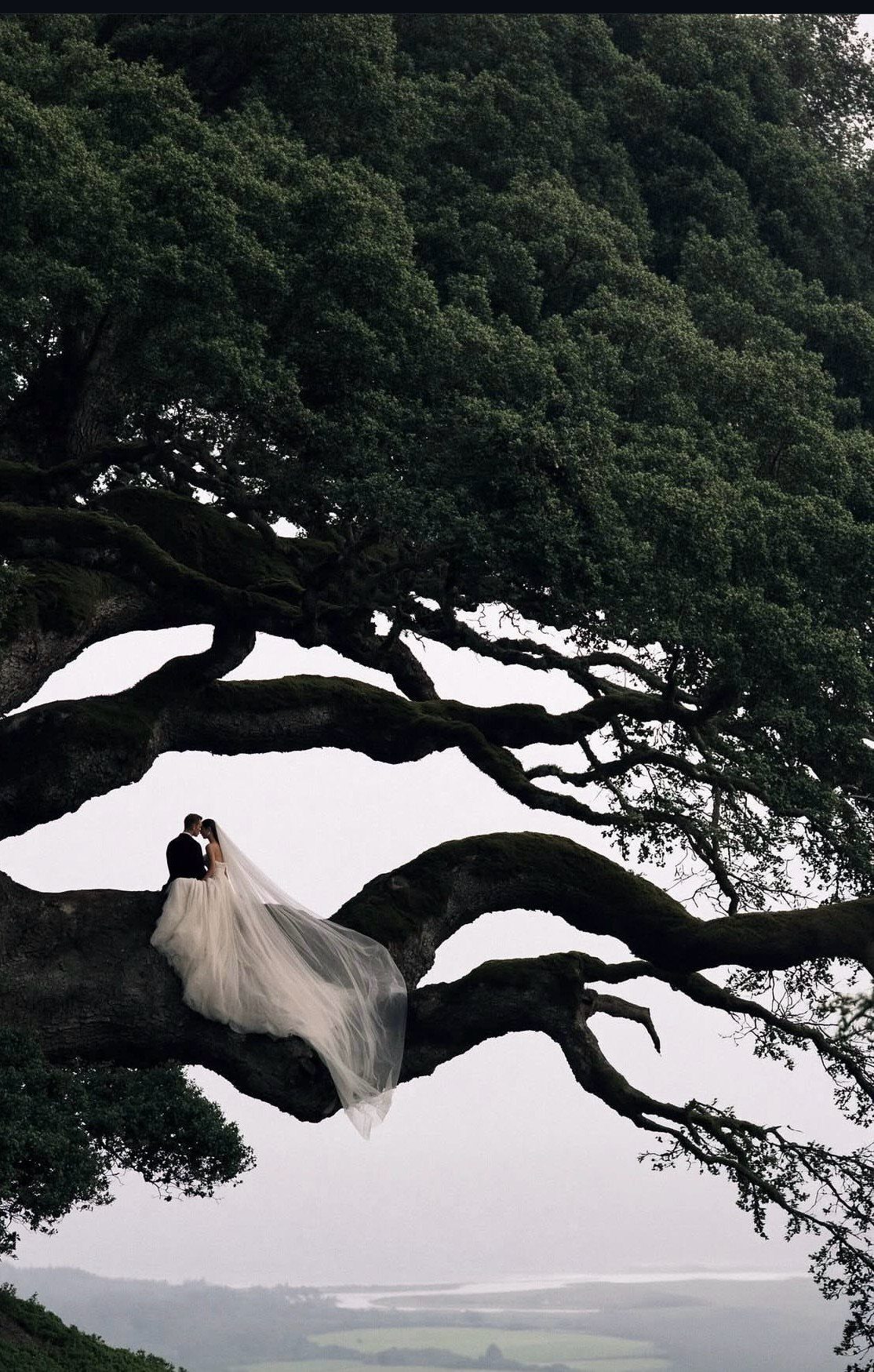
A tree branch, a grove of leaves, or any frame nature provides turns the couple into a vignette without props or cost.
A spreading oak places the pair above the landscape rather than in front of it, which changes who sees what.
This idea suits couples whose venue already has dramatic plantings or who want their portraits outside the usual garden path. Check whether your venue allows climbing or off-trail positioning; some old trees cannot bear weight on upper branches.
Mist below a branch is weather-dependent, so schedule flexibility helps if you are hoping for atmosphere. Leaves or flowers at eye level work as well as overhead framing and need no elevation at all.
10. Couple Exit with Sparklers
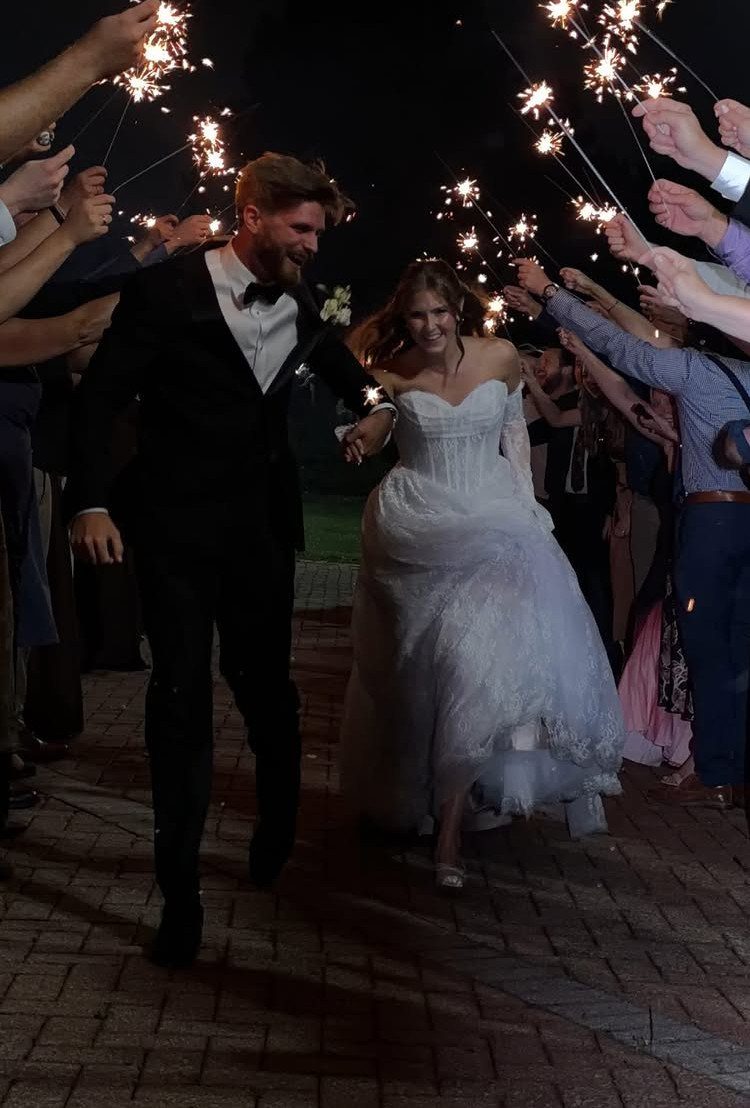
Sparklers burn hot enough to ignite fabric instantly, so the send-off needs coordination more than courage. Guests line both sides of a path, arms raised but with enough space between rows that the couple does not brush against embers.
Night photography with moving light sources requires a photographer who knows how to balance the sparklers against ambient darkness without losing your faces entirely. Brick or pavement underfoot beats grass for both footing and cleanup.
Buy longer sparklers to extend the window for usable shots; short ones burn down before the couple reaches the end. Designate one person to collect spent wires before guests wander off with them.
11. The Cake Cutting
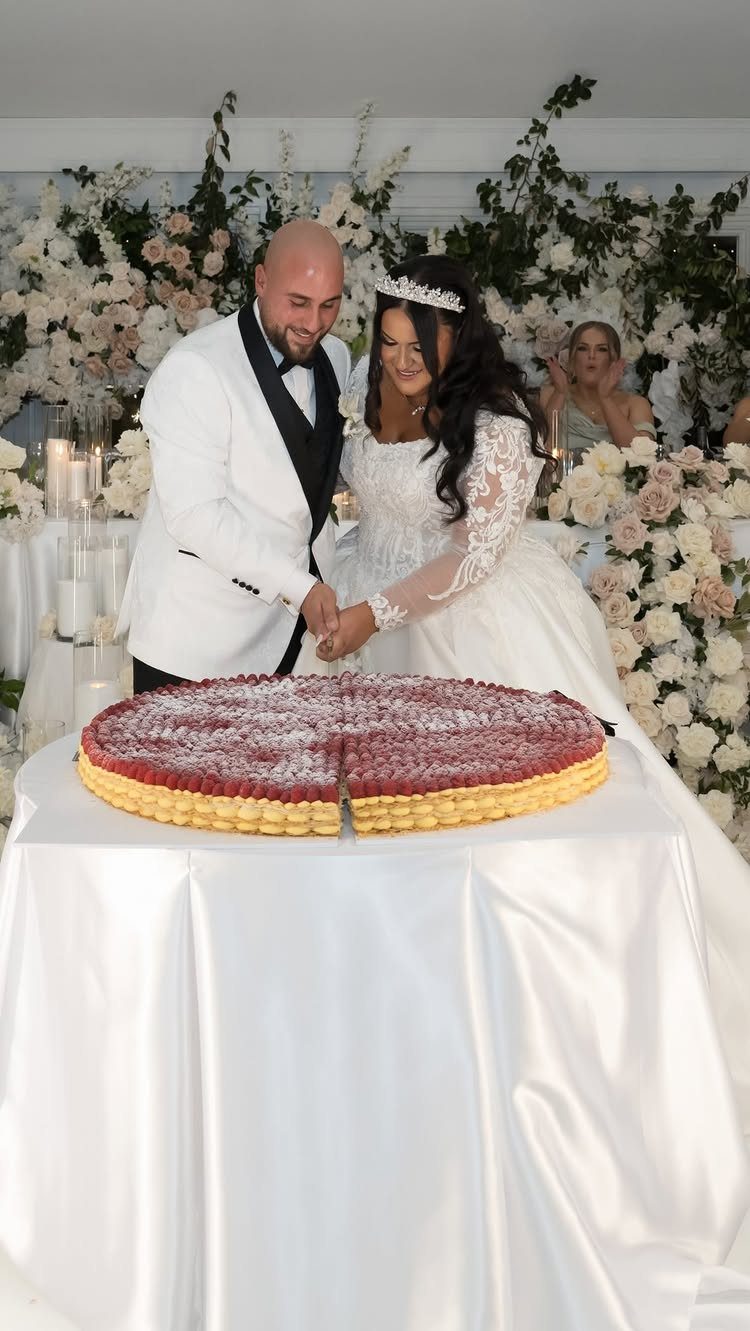
Cutting the cake together gives you a shared task that breaks up the reception and produces a usable photograph without requiring either of you to perform for the camera.
Facing each other rather than the room keeps the moment between them.
Check your venue’s lighting before the reception starts; overhead spots or window glare will flatten the image. A tall floral backdrop adds depth but needs clearance for arms and elbows.
Decide beforehand whether you are feeding each other cleanly or smashing, since hesitation looks worse than either choice committed fully. The person serving should stand ready with plates so the cutting does not drag on.
12. Couple Walking Down the Aisle
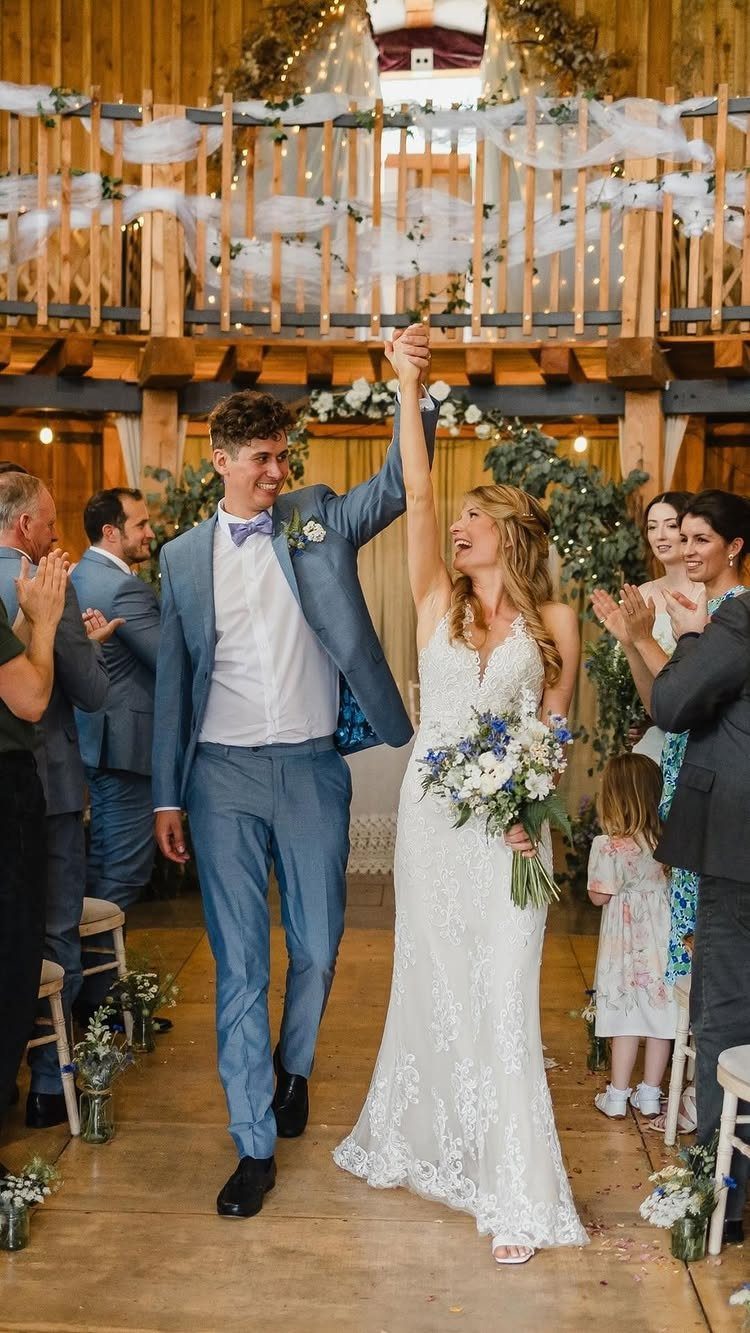
Walking back down the aisle as a married couple differs from the processional: the tension has broken, and guests are already reacting. Raised hands catch that release without blocking faces.
Confirm with your photographer that they will cover this moment; some position themselves at the front for the kiss and miss the exit entirely.
A barn aisle with guests seated close gives immediate applause and confinement that keep the couple centered.
If your aisle is wide or outdoors, the energy can scatter; walking closer together and at a deliberate pace keeps you the clear subject.
Agree with your partner beforehand on whether to kiss, raise hands, or simply hold on and walk.
13. Wedding Ceremony Location
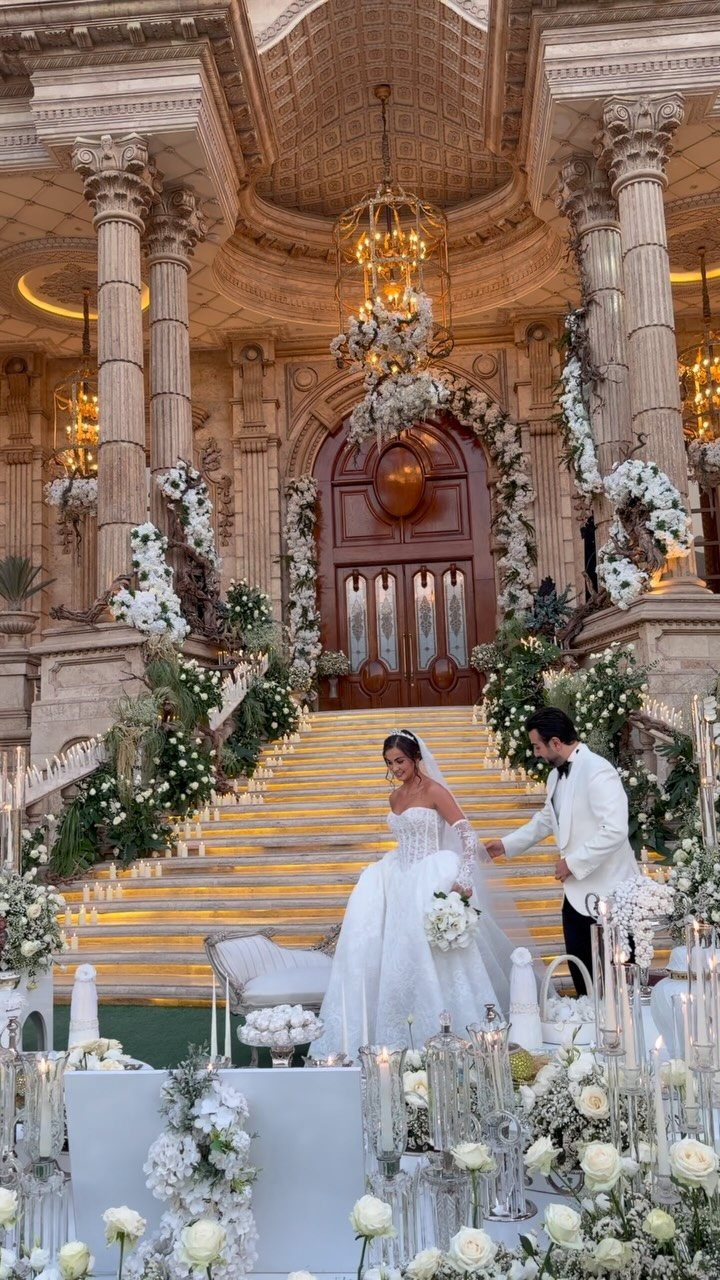
Your ceremony location is the stage your whole day plays on, and the photographs of it become the establishing shots that place everything else in context.
Stone steps with candlelight, a barn’s timber frame, or an open field at golden hour each carry a mood that affects how the rest of the images read.
Ask your photographer to capture the space both empty and full. The room before guests arrive shows the structure and your choices of decoration; the same angle during the ceremony shows scale and emotion together.
If you are still choosing between venues, walk each one at the time of day your ceremony will happen and notice where natural light falls.
14. The Veil
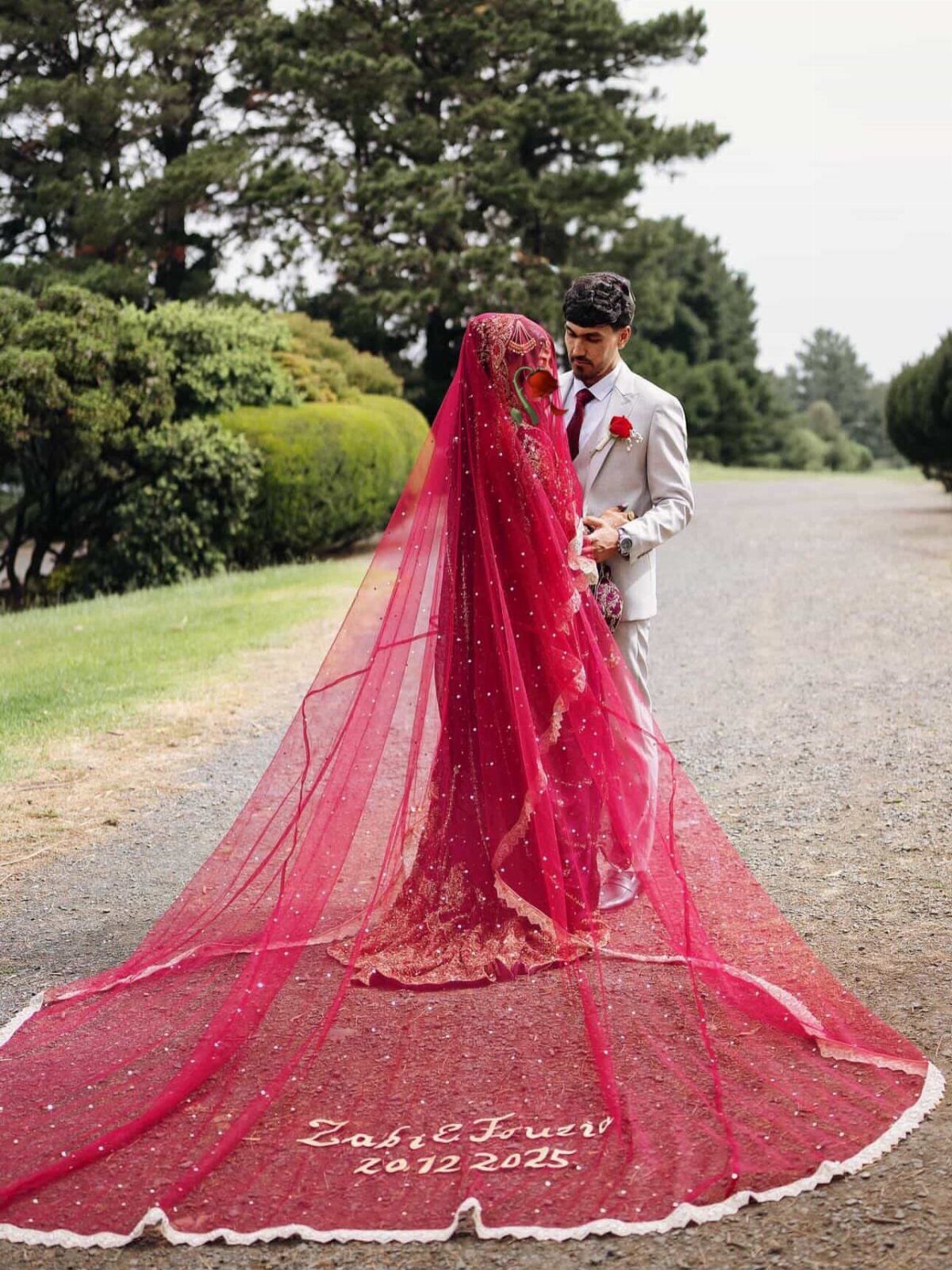
A long veil trailing across gravel or grass turns a simple portrait into something with motion and scale.
The embroidered names and date in the visible version make it a keepsake as much as an accessory, something that survives the day as a physical object with memory attached.
Red stands out against green landscapes and pale stone; white or ivory reads as classic and catches light differently.
Talk with your photographer about how you want the veil handled: held up by an assistant for wind, allowed to fall naturally, or used as a frame that partially obscures both of you in a kiss beneath it.
The fabric matters for weight and how it moves; tulle floats, silk falls straight.
15. The Bridal Bouquet
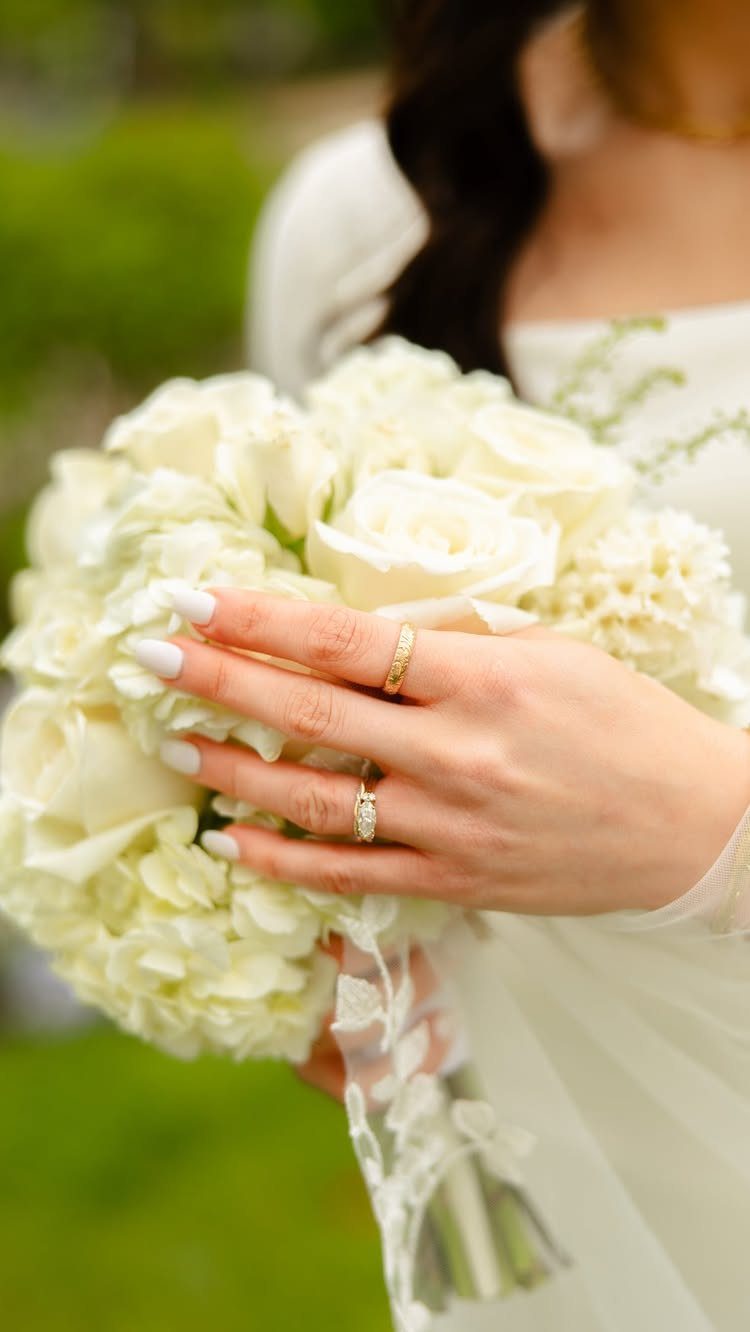
The bouquet appears in more photographs than almost any other detail, yet couples often forget to plan specific shots around it.
A close-up of your hand on the stems, rings visible, gives you one image that holds both the flowers and the commitment they accompany.
Your florist has already chosen stems that hold up without water for hours, but the bouquet still needs care between appearances.
Designate someone to carry it when your hands are full and to set it somewhere visible during getting-ready shots so the photographer can isolate it against a clean background.
White roses and hydrangeas photograph as rounded shapes; spikier flowers need different framing. Ask for one photo of the bouquet alone, placed against a surface or texture from your venue.
16. Silhouettes and Shadows
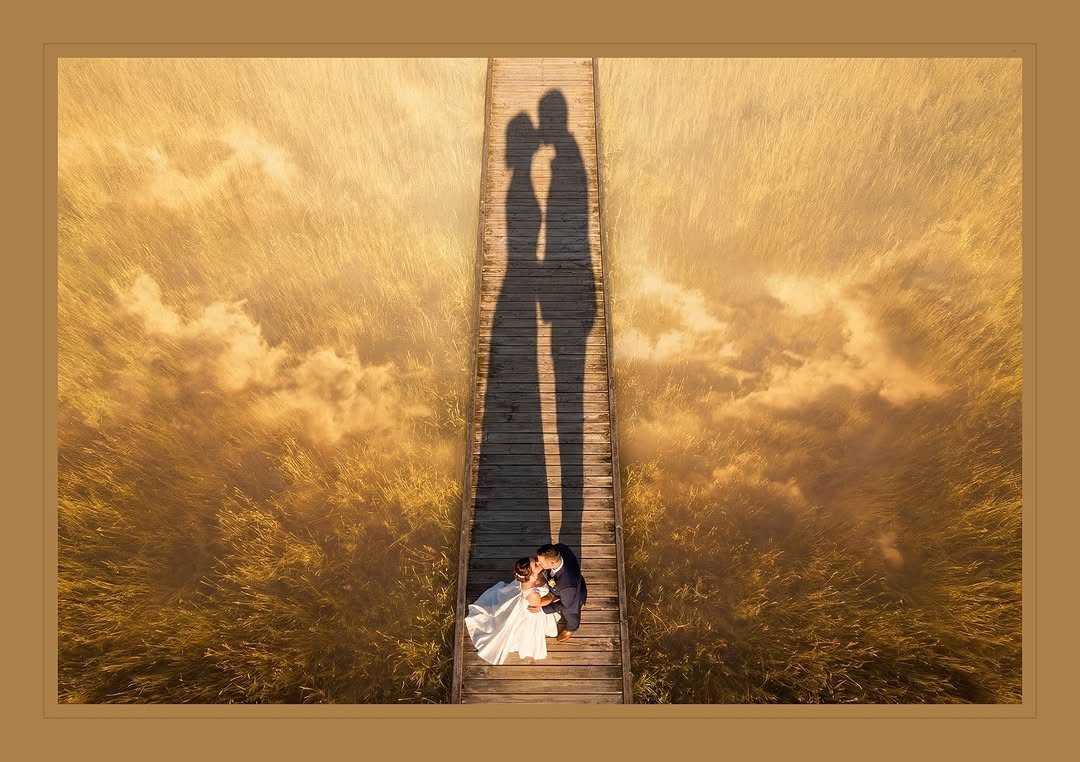
Strong backlight strips a couple down to outline and gesture, which can feel more intimate than a fully lit portrait because the viewer fills in expression from posture alone.
Long shadows across a boardwalk or lawn stretch the moment into something that reads as late in the day, the good light almost gone.
This needs the right angle of sun: too high and the shadow shortens to nothing, too low and the faces lose all separation from background. Your photographer will know the narrow window, usually within an hour of sunrise or sunset.
A wooden path or flat surface gives the shadow something to read against; uneven ground breaks the shape. The pose matters more when no face is visible, so hold the connection deliberately.
17. The Tie Grab
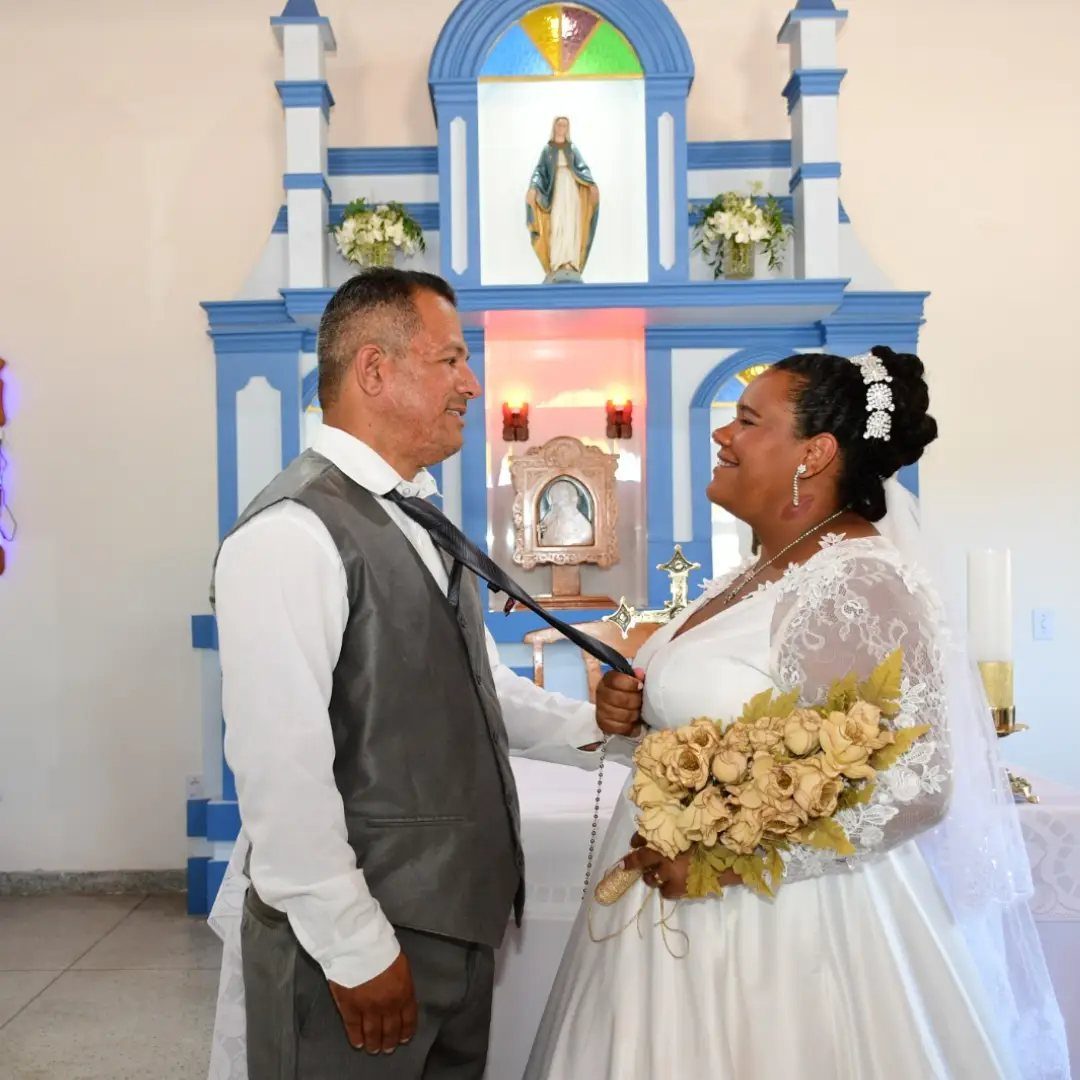
A hand on the tie turns a formal garment into something playful without undressing it completely. The gesture reads as spontaneous even when set up, and it works in a church, a garden, or a hallway between locations.
The groom should leave the tie slightly loosened beforehand; a fully tightened knot does not give the bride enough to grip without strain. Her pull should be gentle, enough to angle him toward her rather than to actually move him.
Sunlight from a window or open door behind them adds warmth that flatters skin tones and separates the couple from darker backgrounds. This pose suits couples who want one image that breaks the solemnity without leaving the setting.
18. Kids Enjoying the Wedding
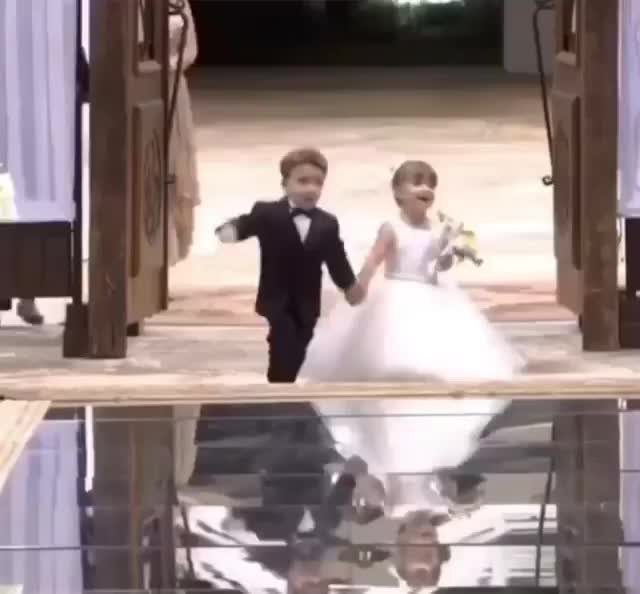
Children at a wedding move on their own schedule, which produces photographs that no amount of direction could improve.
A boy and girl in formal clothes running through a doorway or walking an aisle together carry the day forward with energy that adult processional parties rarely match.
Coordinate with parents beforehand about naps and meals; a child photographed hungry or tired will look it regardless of the outfit.
The formal clothes matter for the image, so build in time for the kids to wear them without worrying about staying clean until the moment arrives.
One adult not in the wedding party should be assigned to each child during key moments, both for safety and so the photographer can focus on the image rather than on preventing a fall.
The running shot needs space and a clear path; check the route for obstacles before the children use it.
19. Flower Petal Shower
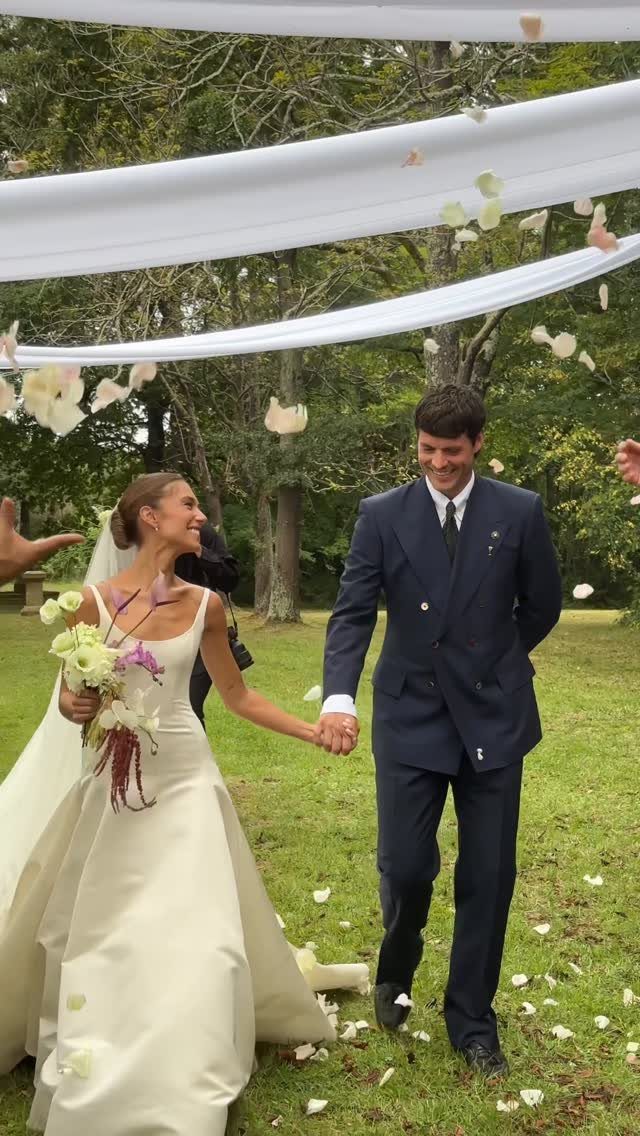
Flower petals soften the moment in a way confetti cannot, drifting slower and reading as celebration rather than spectacle. Guests standing close on both sides can throw them by hand, which keeps the shower dense and controlled.
Rose petals stain light fabrics if they carry moisture, so buy dried or freeze-dried petals and store them in open containers until the last minute.
One to two gallons covers a couple walking 20 feet. The couple should move at half normal speed; the photographer needs the time to catch petals in the air around faces rather than on shoulders after they land.
20. Kneeling Hand Kiss
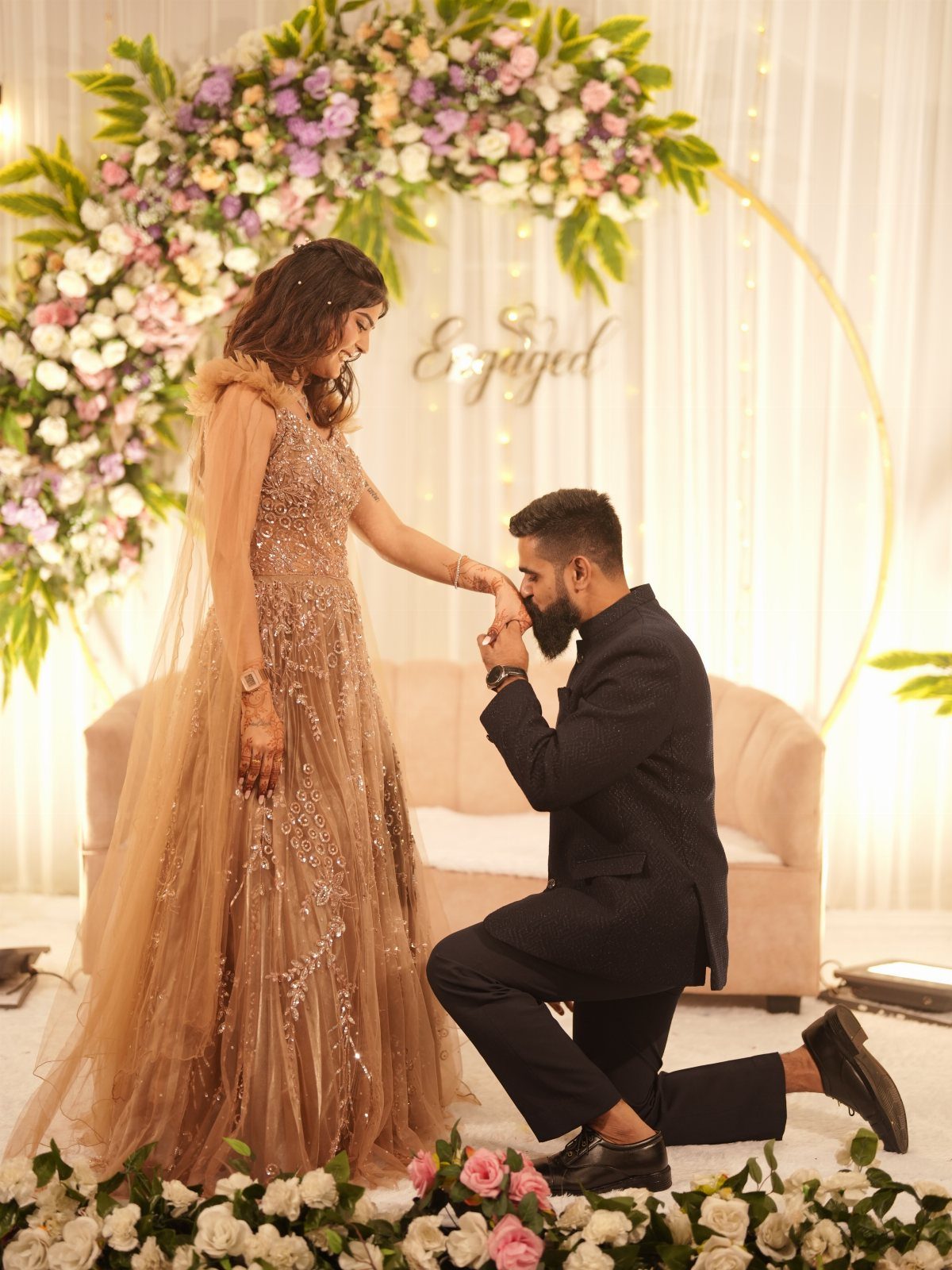
The kneeling hand kiss borrows from courtship to mark a moment that has already become marriage, which gives it weight without heaviness.
The bride’s hand receives the gesture best when her arm hangs naturally rather than extended; the groom supports her fingers from below so the kiss does not pull her off balance.
A backdrop with wording, as in the visible version, places the image in a specific phase; without it, the pose suits a reception or portrait session equally.
The groom’s knee needs a clean, hard surface or a hidden pad; gravel or grass will show in the line of his trouser.
Hold the pose for 3 counts, then release; the photographer captures the approach and the kiss itself, not the recovery.
21. Twirling the Bride
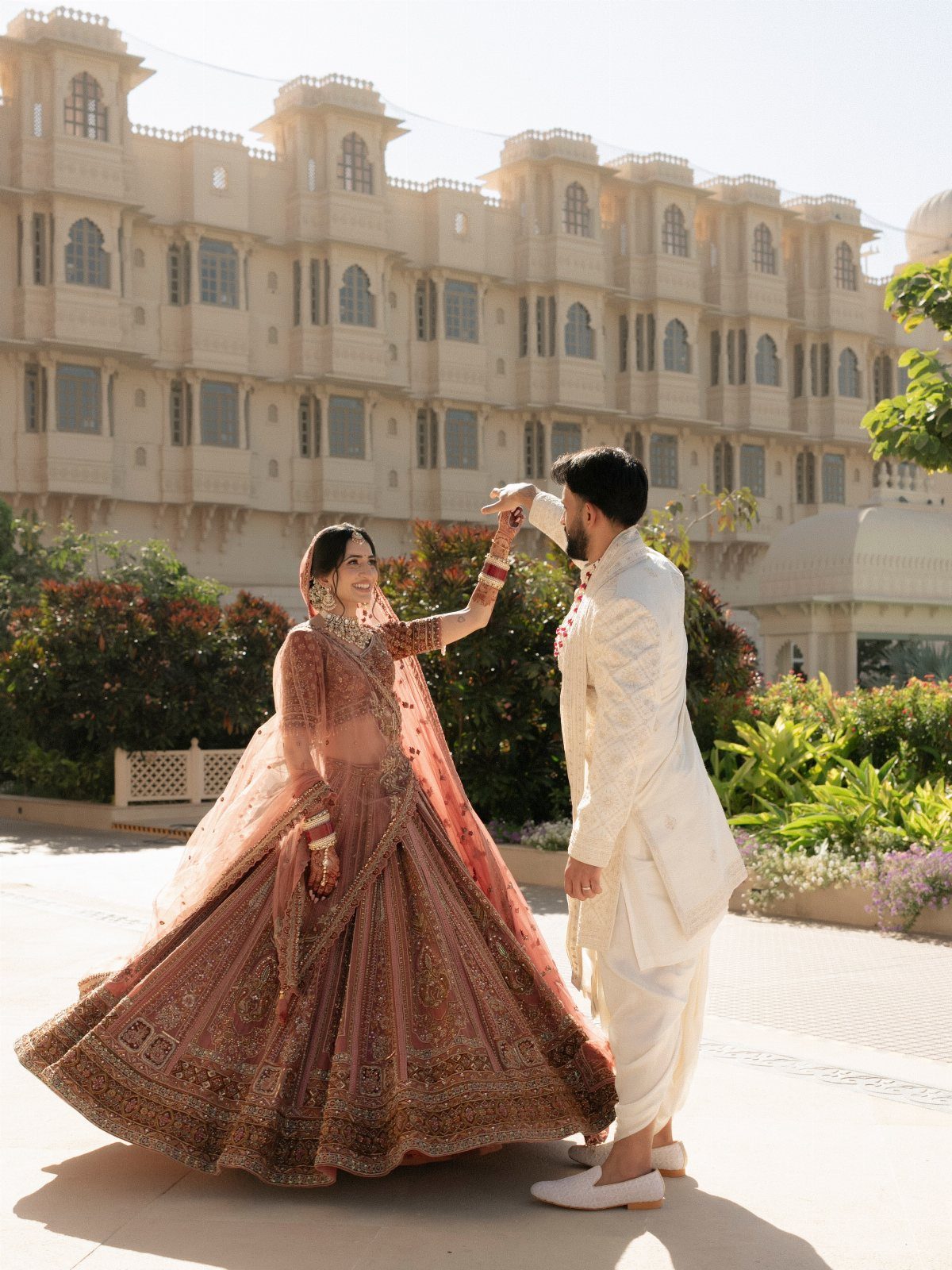
Twirling the bride sets the gown in motion and gives the couple something to do with their hands that still connects them.
The groom’s grip on her fingers or wrist controls the speed; her free hand lifts the fabric at the side or does not, depending on whether the skirt needs help.
A courtyard with stone underfoot reflects sound and gives the twirl an audience; a field or lawn softens the landing if she misjudges.
The turn itself should be one full rotation or less; more than that and the smile becomes fixed, the dress wraps around legs, and the moment turns athletic.
A lehenga with heavy embroidery carries centrifugal force differently than tulle; practice once in the outfit to learn where the weight goes.
22. Bubble Send-Off Exit
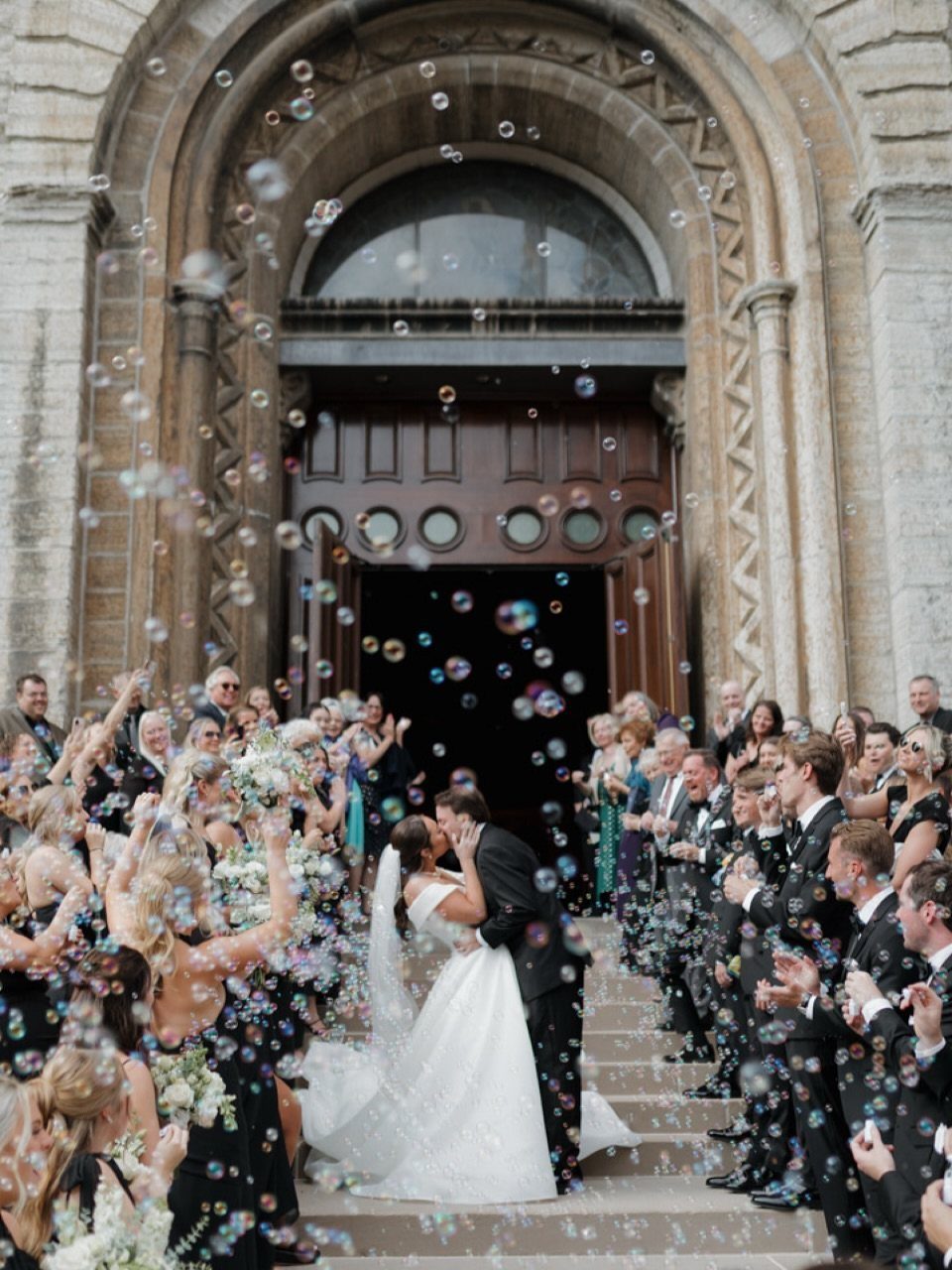
Bubbles leave no residue on fabric and carry no burn risk, which makes them the safe default for venues that ban rice, petals, and sparklers alike.
The effect depends entirely on density; too few guests with wands produce sparse spheres that read as accident, while enough hands produce an atmosphere that surrounds the couple.
Small children blow with less force and create larger, slower bubbles that linger in frame longer; assign them the front row.
The couple should pause mid-kiss or mid-step rather than moving through the line, since bubbles catch light best when still against a dark background.
Stone steps and a light-colored building, as in the visible version, give the bubbles contrast; at night they need backlighting to read at all.
23. Carrying Across the Threshold
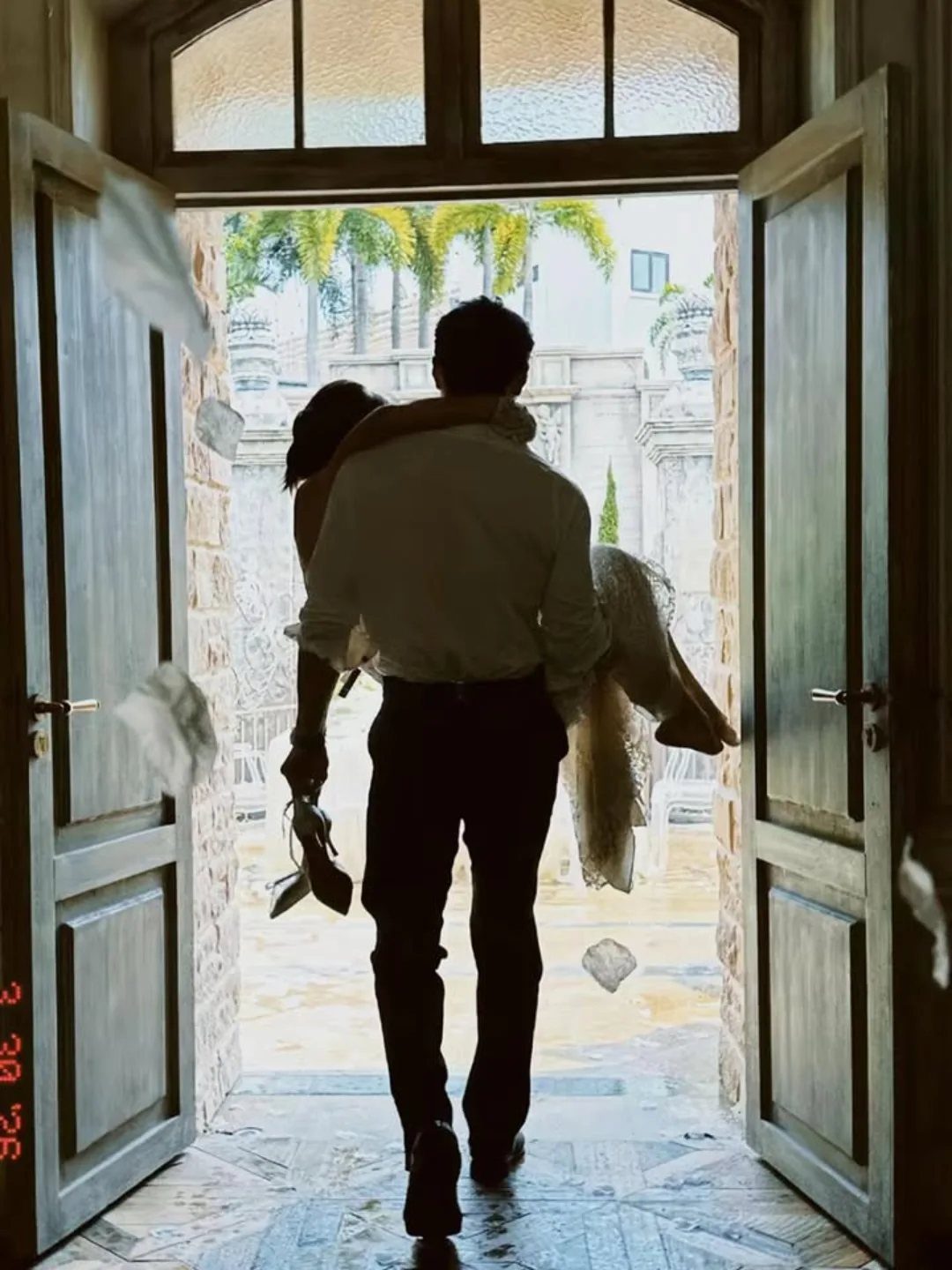
Carrying the bride across a threshold repeats an old gesture with added petals, which turns private ritual into photographable event.
The groom’s arms should pass behind her knees and across her back, the same carry that works over any distance; the bride’s arm across his shoulder steadies her and keeps the dress between them from compressing.
An open doorway with light beyond it frames the couple as silhouette against arrival; a closed door would read as departure instead.
The petals need timing, thrown by someone positioned to the side so they fall across the light rather than into faces.
A bride in a full skirt adds bulk that shifts the groom’s center of gravity; he should test the lift once before petals fly, with the same shoes he will wear.
24. Confetti Drop Shot
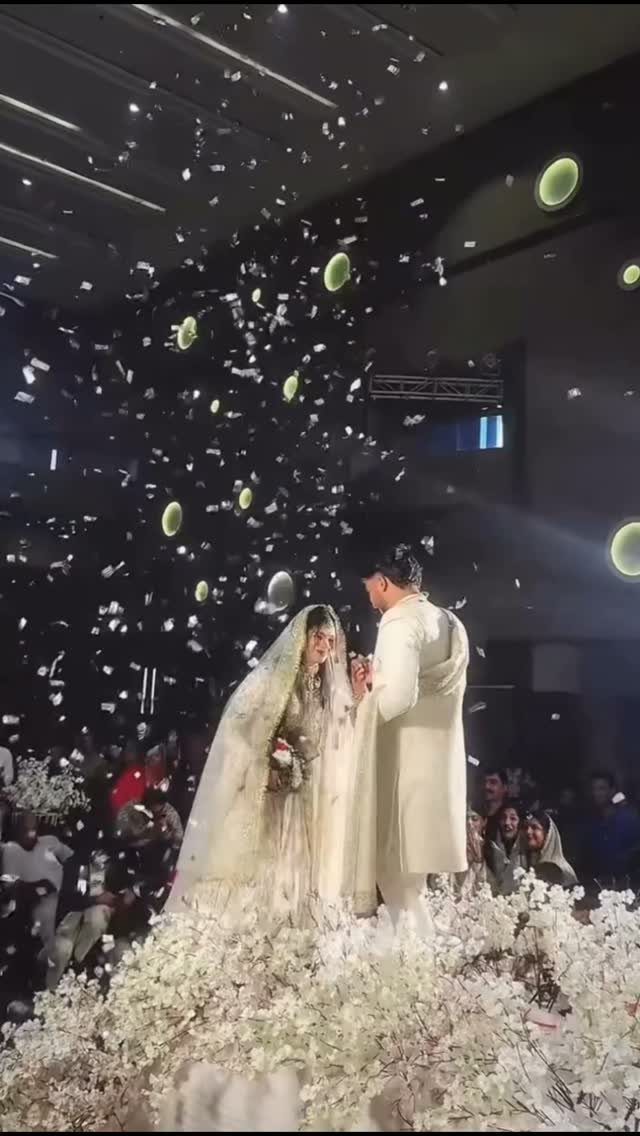
A confetti drop from above surrounds the couple without requiring any guest participation, which makes it reliable for indoor venues where throwing is impractical.
The visible version uses white confetti over white flowers and white attire, which risks flatness; the depth comes from the motion and the guests watching, not from color contrast.
A ceiling-mounted drop bag or a rented confetti cannon releases the load in 2-3 seconds, so the couple must be in position and looking up or at each other before the trigger.
Cleanup clauses in venue contracts often exclude confetti; confirm before ordering. Biodegradable paper dissolves with water but still needs sweeping; metallic film does not and should be avoided.
Confetti for a drop shot needs more volume than you think; spread it thick enough to read as intentional rather than a few stray pieces catching light.
25. Exchanging Wedding Garlands
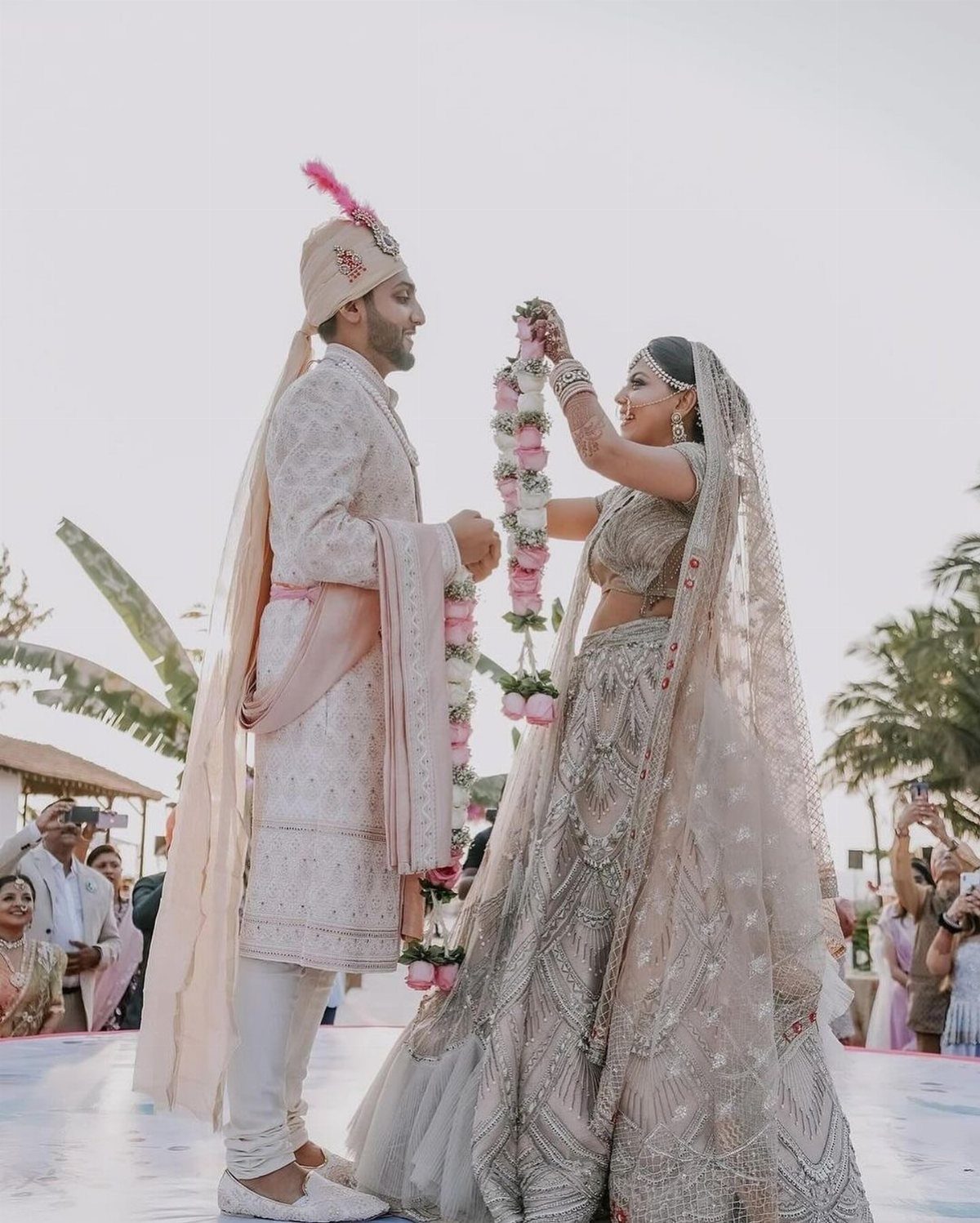
Exchanging wedding garlands places the couple at the center of a ritual that guests witness rather than participate in, which suits smaller ceremonies where every eye is already on them.
The bride and groom face each other at arm’s length, each holding a garland heavy enough to drape without collapsing.
Fresh jasmine and rose garlands hold fragrance for hours but weigh more than silk versions; the exchange itself takes longer with real flowers because both arms must clear the other’s head.
The groom typically receives first, bending slightly so the bride can reach.
Outdoor light, as in the visible version, lets the colors read cleanly against clothing; indoors, a single warm source from behind keeps the petals from flattening into pink and white shapes without depth.
26. Nose-to-Nose Close-Up
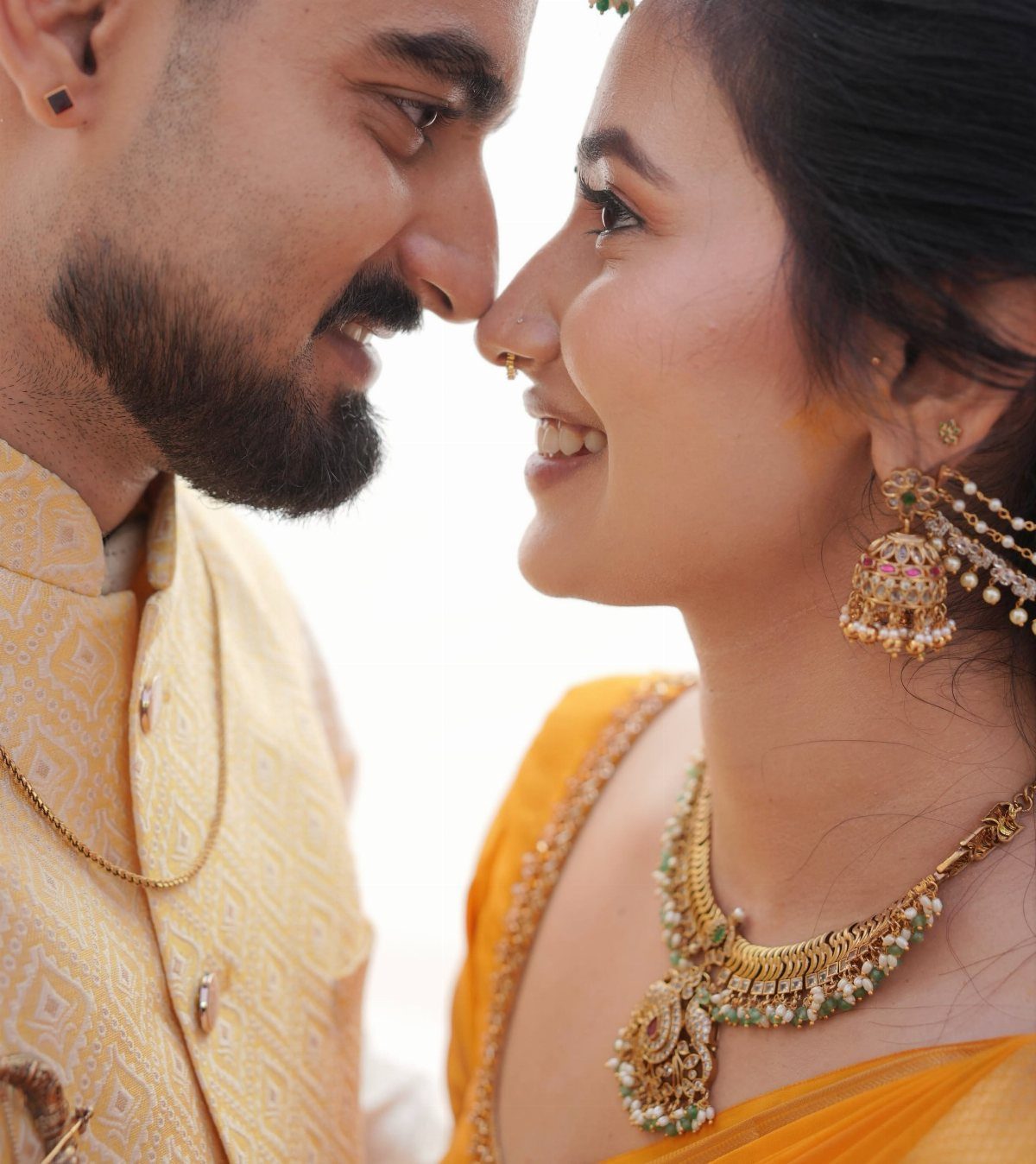
A nose-to-nose close-up strips the scene down to 2 faces and the space between them, which works when the couple wants intimacy without the performance of a kiss.
The photographer needs a lens that does not distort at short range; a longer focal length keeps noses and foreheads in proportion.
Yellow attire against a bright background, as visible here, risks the faces losing definition, so the light must come from the side or behind the couple rather than from the front.
Both should relax their eyes; the smile reaches them even with no mouth visible.
Hold the pose for several frames, since breathing shifts the alignment and one frame will have the better match. This suits couples who want one image that feels private in an album otherwise full of ceremony.
27. Reception Table Portrait
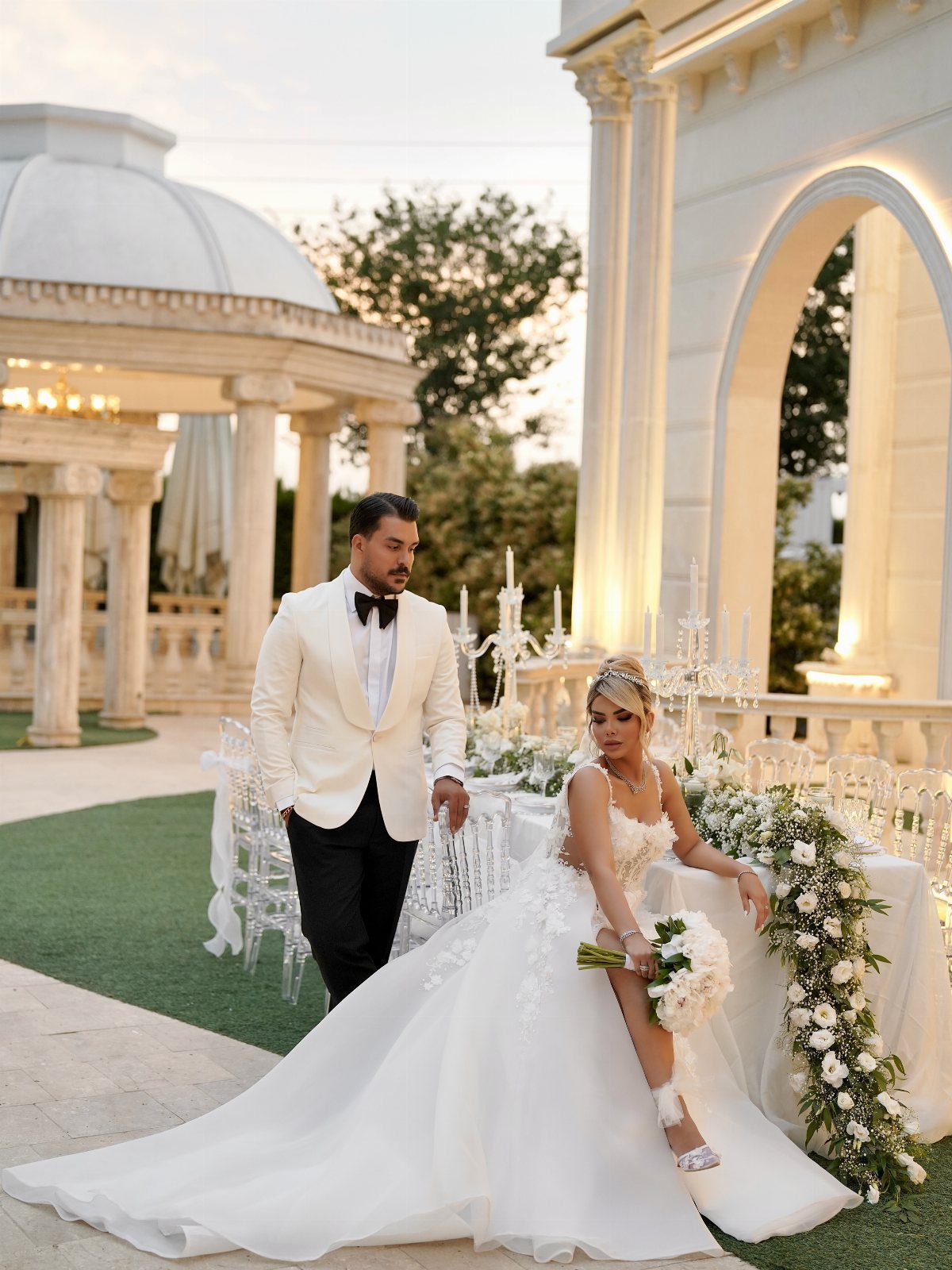
A reception table portrait lets the couple absorb the setting they paid for without the distraction of guests using it.
The bride seated and the groom standing, as in the visible version, breaks the horizontal line of two chairs and two bodies; the height difference gives the photographer a diagonal to work with.
The table itself must be fully set before the couple arrive: candles lit, garlands draped, glasses placed, since half a table reads as oversight rather as than style.
A ballgown fills the frame beside the seated figure; a slimmer dress needs more of the table visible to balance the composition.
Outdoor tables need the light right; late afternoon sun from behind the couple turns them into silhouette against the settings, so shoot when the light is lower or from the side.
The couple should touch only lightly, a hand on a shoulder, since full embrace would compress the dress between them and the table edge.
Tips for Natural Poses
The fastest way to look stiff in a photograph is to try to hold still. I have watched couples freeze mid-pose while their photographer adjusts a light, and the tension stays visible for frames afterward.
Movement helps: shifting weight from one foot to the other, letting your hands find each other again after separating, breathing out before the shutter clicks. These small motions keep your face alive.
Practice matters more than most couples expect. Stand in front of a mirror with your partner and run through the poses that appeal to you, especially any lift or dip that depends on balance.
Notice which angles of your face read as tired or harsh under bathroom lighting, since that is roughly the honesty a camera brings.
An engagement session gives you the best rehearsal: real lenses, real pressure, enough time to discover whether you relax better with music playing or in silence.
Importance of Lighting
The hour after sunrise and the hour before sunset produce the most forgiving light for formal portraits.
Midday sun falls straight down, carving shadows under eyes and chins that no pose can fix. If your ceremony runs noon to one, plan couple portraits for later or accept that some locations will need full shade.
Cloud cover acts like a softbox, which is why overcast wedding days often yield better color than blue-sky ones.
Indoor ceremonies vary more: a barn with high windows reads differently at 2 PM than at 5 PM, and the difference shows in your photographs.
Walk your venue at the exact hour you will marry, not at the hour you signed the contract.
Artificial light needs testing.
Overhead spots flatten cake-cutting images unless your photographer brings their own source or bounces what exists. Ask specifically how they handle dim reception rooms; the answer separates photographers who plan from those who hope.
Incorporating Personal Elements
Your wedding photographs carry more weight when they include something that existed before the planning began.
A tree you walked past on early dates, the steps of the building where you met, a neighborhood street that belongs to your shared history: these locations turn generic portraits into evidence of a specific relationship.
Objects work the same way. A book you both read, a record you played repeatedly, the mug you fought over in your first apartment: handled naturally in a portrait, these items give viewers entry into who you actually are.
The risk is overstaging, turning the object into a prop that dominates the frame. Hold it or stand near it; do not present it to camera like a product shot.
Your florist and your venue already made choices about atmosphere.
Push further only when the personal element genuinely matters to you both. One meaningful location beats three that sound impressive in a caption.
Working with Your Photographer
If you want laughter during the lift or motion in the walk, say so before you sign a contract. Their portfolio should already show what they value.
Group portraits demand assertiveness from whoever is behind the camera.
Large collections of relatives scatter and regroup slowly unless someone with authority directs them. Ask whether your photographer takes that role or whether you should assign a family member to assist.
Parent dances often happen in light too dim for color without flash. Your photographer has handled dim churches before, so ask what they actually do: bounced flash, higher ISO, black-and-white conversion, or some combination.
Their answer tells you whether they have solved this problem before or are figuring it out on your clock.
Frequently Asked Questions
Who should the bride and groom take pictures with?
Family, your wedding party, and close friends are the standard groups. If you want specific group shots, tell your photographer beforehand so they can allot time before everyone disperses.
What are some good couple poses for wedding photography?
Walking while holding hands with a little space between you shows more personality than standing pressed together.
The forehead kiss reads tender without being performative, and looking into each other’s eyes during the first dance gives the image its center of gravity.
Motion beats stillness: the twirl, the walk toward camera, and the lift all turn static poses into something alive.
What are some cool ideas for wedding photos?
If you want the lift shot, rehearse it once in the dress or suit; a ballgown weighs and moves nothing like street clothes, and the first try is not the one you want on camera.
Sparklers at night require longer burn times and a photographer who knows how to balance moving light against darkness.