Simple decor for wedding celebrations in 2026 runs from $3 cheesecloth yards to borrowed brass candlesticks, and the single factor that sorts one idea from another is whether you have more time or more help. The trick most couples miss is timing: bulk roses bought five days out stay closed, and confetti packets left unsealed absorb morning dew into damp clumps. At $33,000 average, The Knot’s 2026 figure means the under-$10 table runner that still photographs soft matters more than ever.
1. Cheesecloth Table Runners

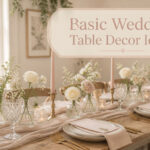
Cheesecloth table runners started for me with a mistake: I ordered a finished runner online and the color was off by half a shade, enough to clash with the linen napkins already paid for. Buying fabric by the yard fixes that. A local fabric store or any online seller stocks cheesecloth in widths and tones you can hold against the rest of the table before cutting. Figure roughly $3–$8 per yard depending on weight and bleaching, and one yard usually covers a standard eight-foot banquet table with gentle pooling at the ends. Cut with pinking shears or a straight blade; the raw edge is the point.
The Knot puts the 2026 average wedding cost at $33,000. Against that number, table dressing that runs under ten dollars per table and still photographs soft and intentional matters. Cheesecloth works laid over a solid cloth or directly on bare wood. It wrinkles beautifully, so "pressed" is not a verb you need. Layer two lengths at different angles if the weave feels too thin under venue lighting. The DIY route also means leftover fabric becomes napkin ties or ceremony aisle markers without a second shipping charge.
2. Bud Vases for Mini Bouquets
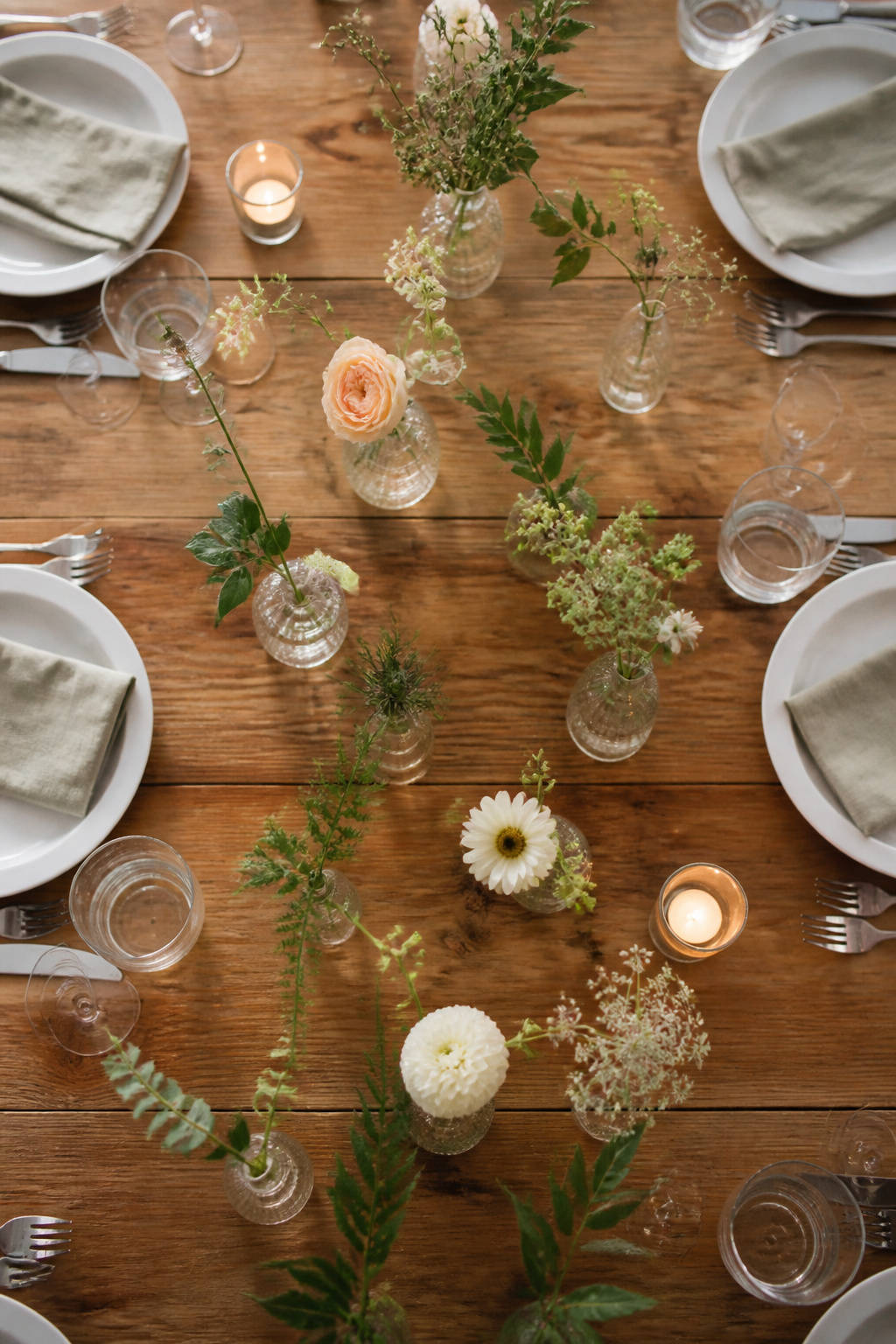
A cluster of small vases down the center of a table reads more intentional than a single bulky centerpiece, and the gaps between them leave room for conversation and passing dishes. Bud vases run tiny, which means a stem or two fills the whole vessel and your floral budget shrinks without looking sparse. Scatter them in groups of three or five, mixing heights and shapes so the line down the table breaks instead of marching.
Sourcing is where this idea pays off. Glass bud vases sell for pocket change at thrift stores, and a mismatched collection looks deliberate once the flowers go in. For the stems themselves, bulk flowers from Costco or Trader Joe’s work better than you’d expect, especially if you lean on greenery that fills space without technique. The minimal look forgives a lot; a few stems of eucalyptus in a two-inch cylinder still photographs clean.
3. Thrifted Vintage Decor
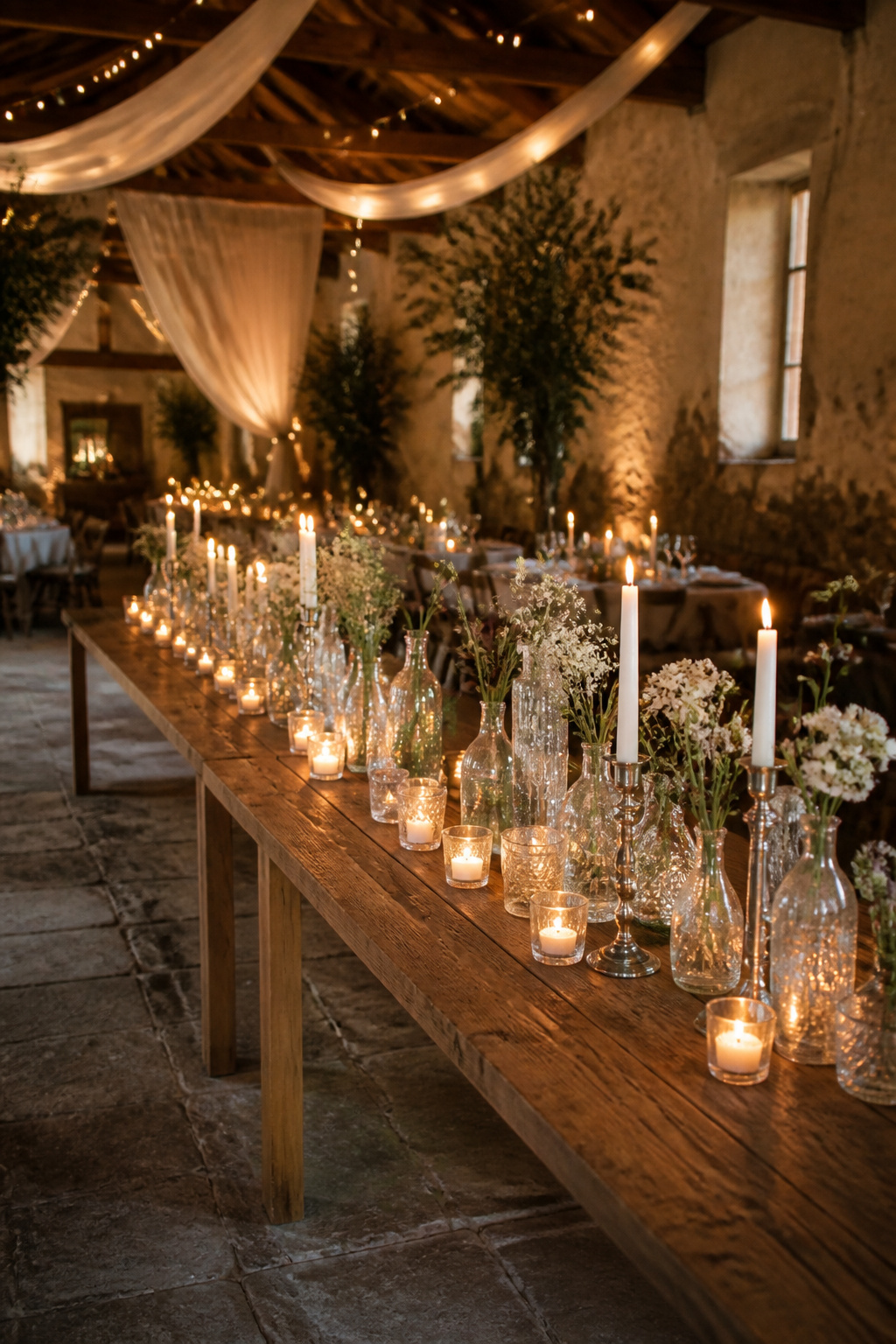
A mismatched set of glass vases from the thrift store runs a few dollars apiece and does more for the room than matching rental pieces three times the price. The trick is clustering them at different heights so the eye travels, not stopping on any single centerpiece long enough to notice the chipped rim on the third one from the left. Candle holders work the same way; brass tarnishes unevenly, and that variation reads as warmth under reception lighting rather than neglect.
Antique signs and small borrowed frames fill the gaps between tables. One couple I read about lined their ceremony aisle with wooden lanterns, then moved those same lanterns to the guest tables for the reception. The baskets that held flower girl petals became favor containers by evening. The ceremony-to-reception shift is where thrifted decor earns its keep; you are not buying twice for the same visual effect.
The risk is over-collecting. Three mismatched styles read as intentional curation. Seven read as a garage sale took over your wedding. Stop while the tables still feel chosen, not accumulated.
4. Paper Lanterns

Paper lanterns fill vertical space for almost nothing, which is why they show up at so many weddings I see in my editing queue. A 12-inch globe runs a few dollars, and the larger ones, 18 inches or even 24, scale up without scaling the budget much. The trick is buying them in bulk and hanging them at varied heights rather than marching them across the ceiling like a string of beads.
Ceilings below nine feet are where they work best, because the lantern itself needs breathing room. In a barn or tent with exposed beams, clustering three sizes together at different drops creates depth without clutter. I have seen photographers struggle when couples hang them too low over the dinner tables; the light pools beautifully but faces fall into shadow. Keep the densest clusters over aisles or dance floors, where no one is trying to read a menu or catch a expression.
5. DIY Floral Arrangements
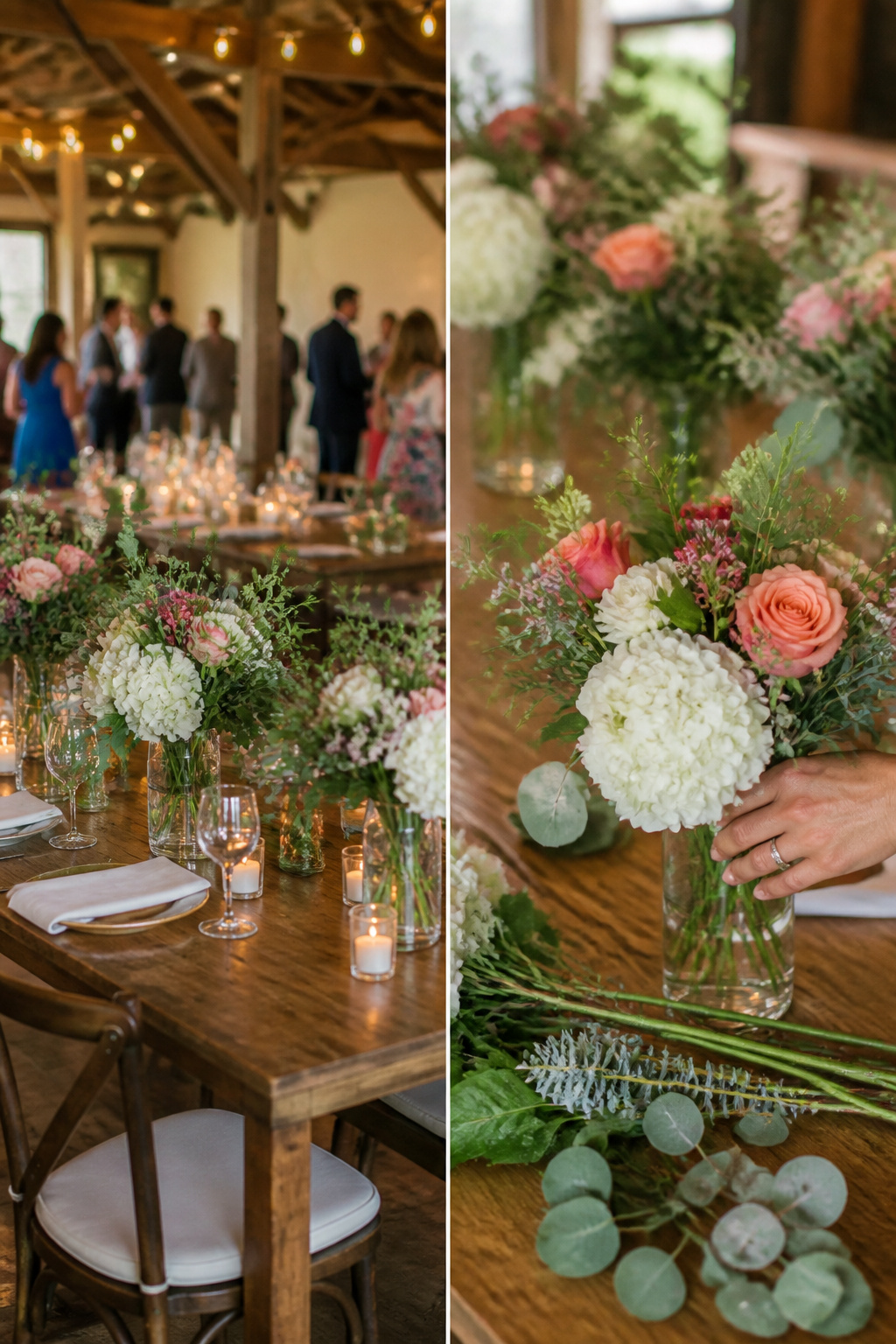
Bulk flowers from Costco or Trader Joe’s can drop your floral budget by more than half compared to a traditional florist, but the savings come with a learning curve I didn’t respect the first time. I ordered three dozen roses and a bucket of greenery for a friend’s shower, convinced I could assemble centerpieces the morning of. The blooms hadn’t opened, the water in my buckets was lukewarm, and by noon half the stems had bent necks from sitting too long in the car. Greenery-heavy arrangements in small bud vases would have been the smarter play; they need almost no advance conditioning and forgive clumsy hands.
Now I tell people to buy five days out, keep stems cold, and practice one full arrangement at least a week ahead. That trial run costs maybe $12 in bulk stems and saves you from discovering at 9 a.m. on wedding day that your "simple" project needs four hours you don’t have.
6. Mix and Match Candles and Glassware
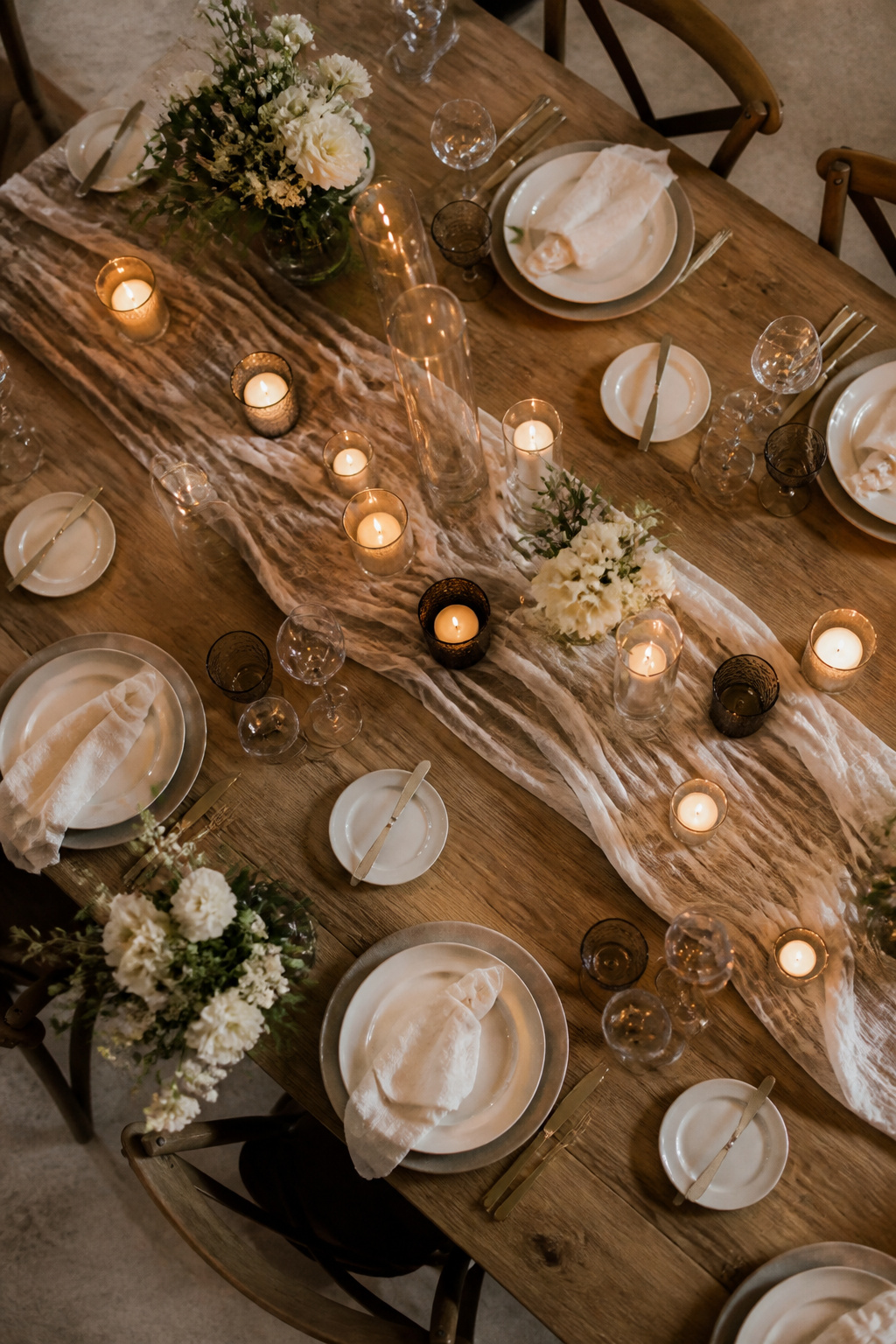
Glassware looks better when it has lived a little. Dollar Tree and Ikea carry basic candle holders, vases, and drinking glasses for next to nothing, and the slight differences between them are what make a table feel collected rather than catalog-ordered. I started picking up single pieces whenever I spotted a shape I liked, and by the time I had twenty or so, the heights and rim diameters varied enough that grouping them felt effortless.
The collected-over-time approach wins on two counts. First, you sidestep the uniformity that makes rented decor look rented; matched sets read as temporary, which is fine for a corporate dinner but not what most couples want at a wedding. Second, you spend less. A single votive holder from a rental company often costs more than buying one outright at a discount store, and you keep it afterward or pass it along.
Mercury glass votives in silver or gold catch candlelight well, though you will need to supply your own tea lights. Clear glass works too, especially if your venue has competing colors you do not want to amplify. The move is simple: cluster three to five pieces at different heights, light them, and let the uneven edges do the work.
7. Printed Couple Photos in Thrifted Frames
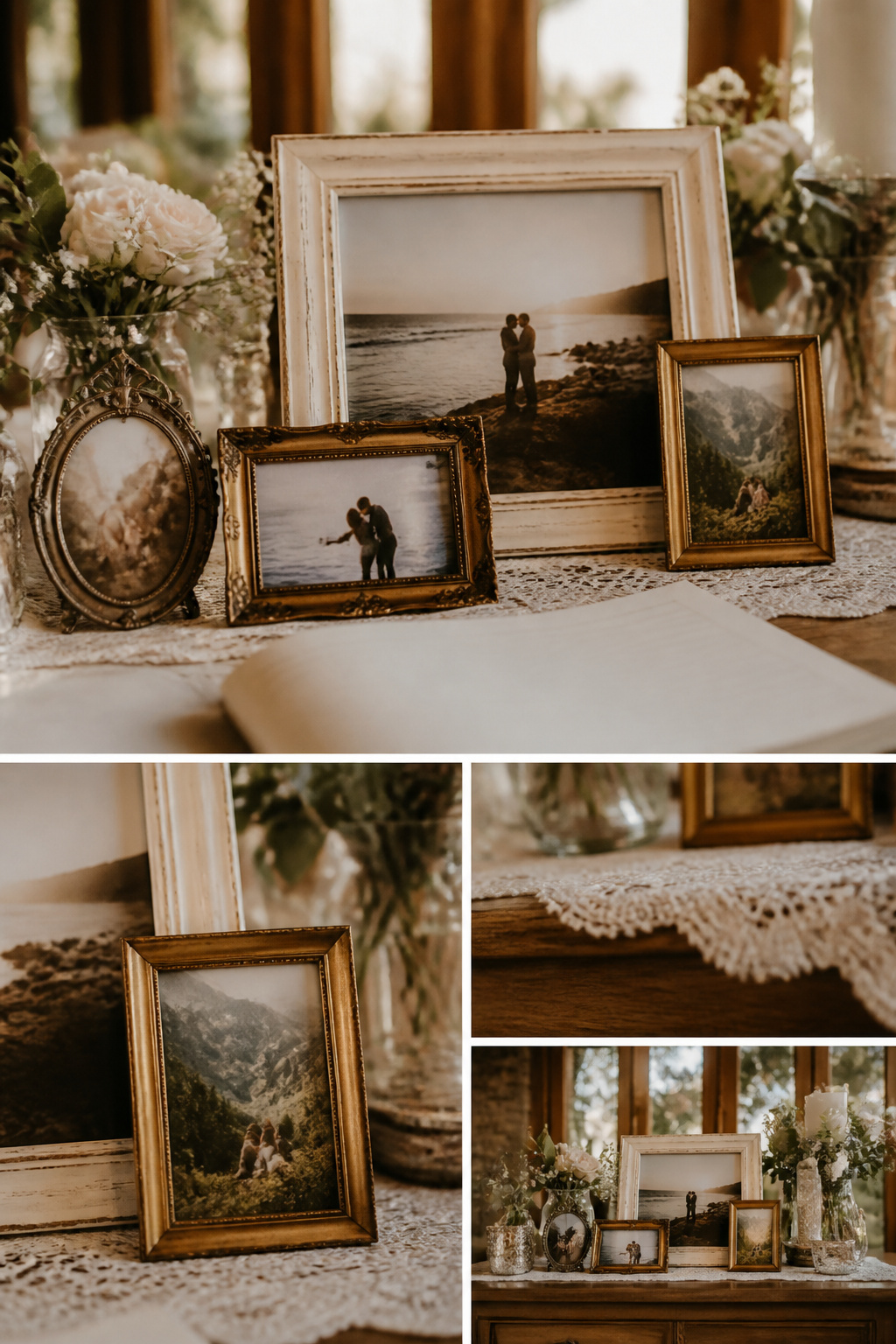
Mismatched thrifted frames turn a wall of couple photos into something that feels collected over time rather than bought in one afternoon. The frames themselves become part of the story: a tarnished brass oval from a estate sale, a water-damaged wood rectangle with chipped gold paint, a plain black 8-by-10 that cost two dollars. Baby photos, vacation snapshots, engagement portraits, and even vintage wedding photos borrowed from parents or grandparents all sit together without matching. The cost stays low because the frames come from secondhand shops or family attics, and the assembly is just arranging until the mix feels right rather than symmetrical. Set the heavier frames lower on the table or wall so the display doesn’t topple visually — lighter, smaller pieces belong higher or toward the edges. The personalization every source mentions is real, but the execution matters more than the sentiment: a grid of identical store-bought frames with identical matting reads as decoration, while the thrifted version reads as evidence of an actual life lived.
8. Fabric Backdrops

A fabric backdrop is one of the simplest ways to claim a corner of your venue and turn it into something intentional. I watched a couple last spring drape three thrifted tablecloths over a borrowed PVC frame, and the ceremony photos came back looking like they had rented a custom arch. The trick is letting the material do the work instead of your construction skills.
Cheesecloth by the yard is the material that keeps coming up, partly because it is cheap and partly because the loose weave catches light in a way that reads as atmosphere rather than decoration. Thrift stores are the other obvious source: vintage curtains, linen scraps, and worn tablecloths that would look tired on a dining table read as texture when they are hung vertically and backlit. The sources point to local fabric stores and online sellers for cheesecloth, but the secondhand route is where you find the pieces that do not match, which is often the point.
Hanging methods stay simple because they have to. Pipe and drape kits, tension rods between two ladders, or even a clothesline strung between trees will hold fabric if you weight the bottom hem. The mistake is treating the fabric like a wall; it needs to move slightly, to have folds and shadows, or it flattens into a bedsheet. A backdrop that breathes photographs better and asks almost nothing of your setup time.
9. String Lights
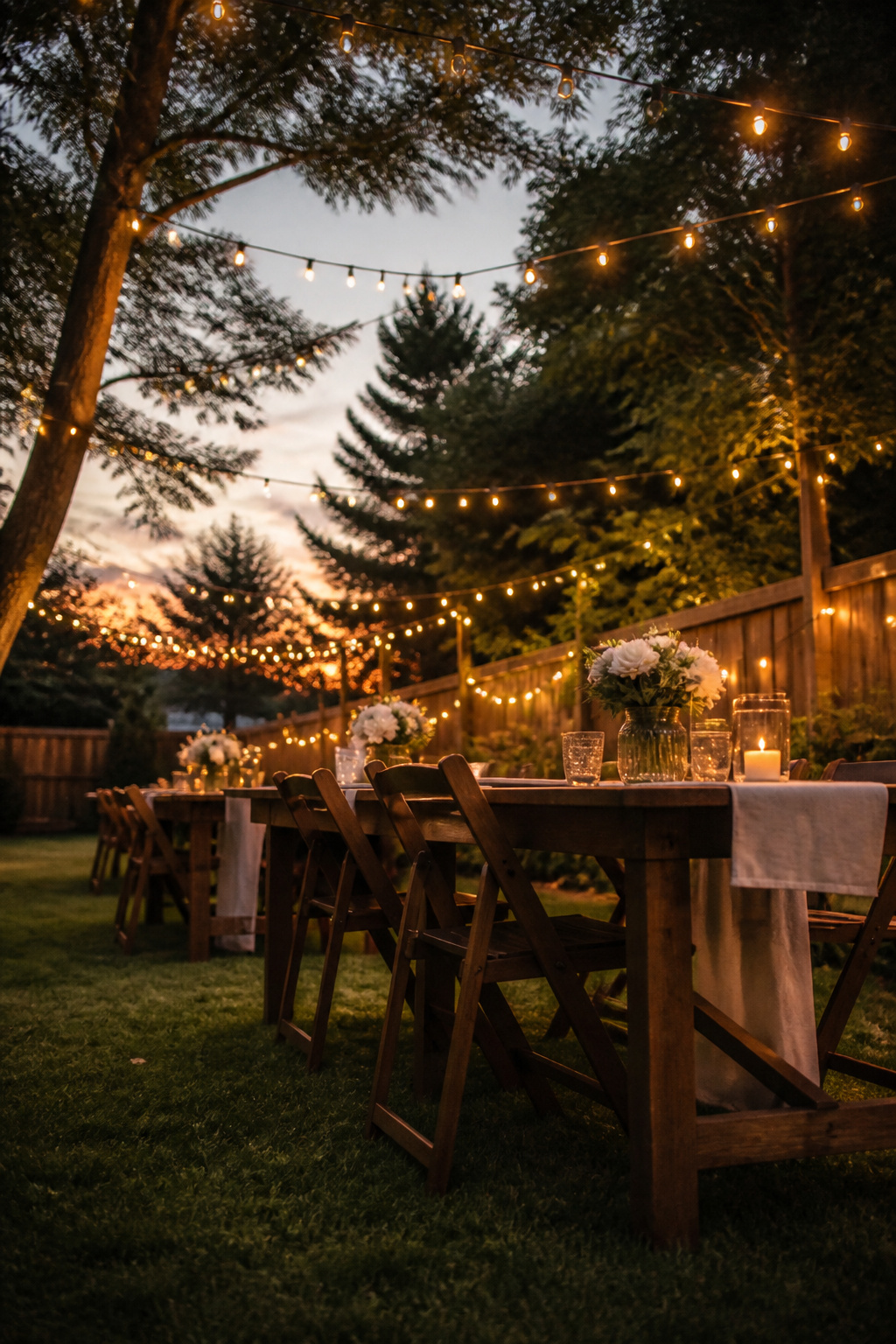
String lights give a wedding the one thing you cannot fake: depth. They push the walls back, lift the ceiling, and turn a rented hall into somewhere your guests want to stay. The trick is buying them at the right moment. January clearance racks hold the same inventory at half price, and the only difference between "holiday" and "wedding" is the box they came in.
Warm versus cool white is where I once guessed wrong. The venue looked sterile under bulbs I had grabbed in a hurry, too blue against skin tones and cake frosting. Warm white, 2700K, is the safer bet for anything involving food or dancing. Cool white works only when you are pairing it with silver metallics or winter palettes, and even then it reads as corporate unless you dim it way down.
LED fairy lights stay cool after hours of running, which matters more than it sounds when they are woven through centerpieces guests lean across. They draw almost no power, so a standard outlet handles more strands than you will likely own. Run them up aisle edges, across a head table, or let them hang in loose curtains behind the ceremony spot. The installation is simple enough to handle the morning of, which leaves the budget for bulbs rather than labor.
10. Borrowed Decor from Friends and Family

The zero-cost option that actually works is using what your friends and family already own. Vases, candelabras, vintage books, fairy lights, framed wedding portraits from your parents or grandparents, these sit in closets and on shelves waiting for a reason to matter.
The risk is the scattered-garage-sale look. I avoid that by borrowing in multiples: six matching brass candlesticks from one aunt, a dozen mason jars from a cousin who cans tomatoes every August. Repeating a single shape or material across several tables reads as intentional, not accumulated.
Color is where it falls apart if you are not careful. Borrowed frames in oak, walnut, and painted white will fight each other unless you unify them somehow. Group the warm tones on the guestbook table, the painted ones near the bar, and let distance do the rest of the work.
Some wedding venues keep their own inventory of decor pieces, signage, cake stands, candles, table runners, available at no extra charge for booked clients. It is worth asking before you start making phone calls to relatives. Borrowed decor works best when it carries a story your guests can almost guess at, a familiar shape from someone’s living room, now holding your flowers.
11. Reusing Bouquets
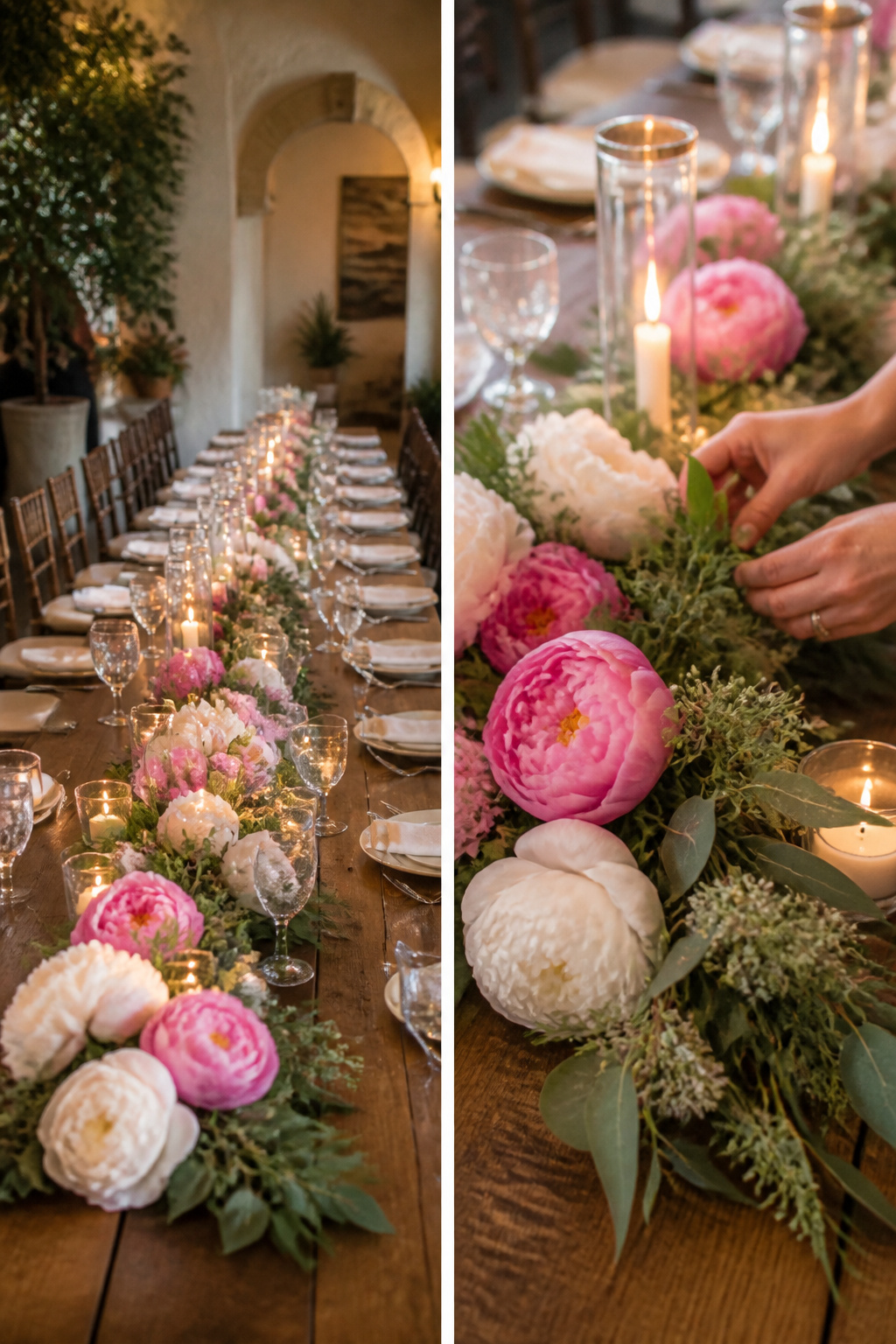
The bridesmaid bouquets lined the head table at a wedding I shot last spring, laid flat like a runner down the center. The florist had already stripped the lower stems so they sat low and clean, no dripping water, no vase cluttering the shot. Move ceremony flowers to reception tables within the hour and they will not miss a beat; leave them in a warm car while cocktail hour runs long and the peonies will open past their prime.
Water is the part nobody pictures. Bouquets come wired and taped, not stem-ready for a vase. If you want them standing in water at dinner, ask your florist to leave extra stem length and skip the full wrap. Otherwise plan to lay them flat, which costs you nothing and still reads as intentional. One couple I watched had their planner transfer aisle arrangements to the guest book table with a misting bottle in hand; the hydrangeas held until the last dance because she hit them twice, not once, and never let them sit in direct afternoon sun through the venue windows.
Timing beats technique here. The flowers do not care how pretty the table looked in the mood board.
12. Home Decor Items as Wedding Decor
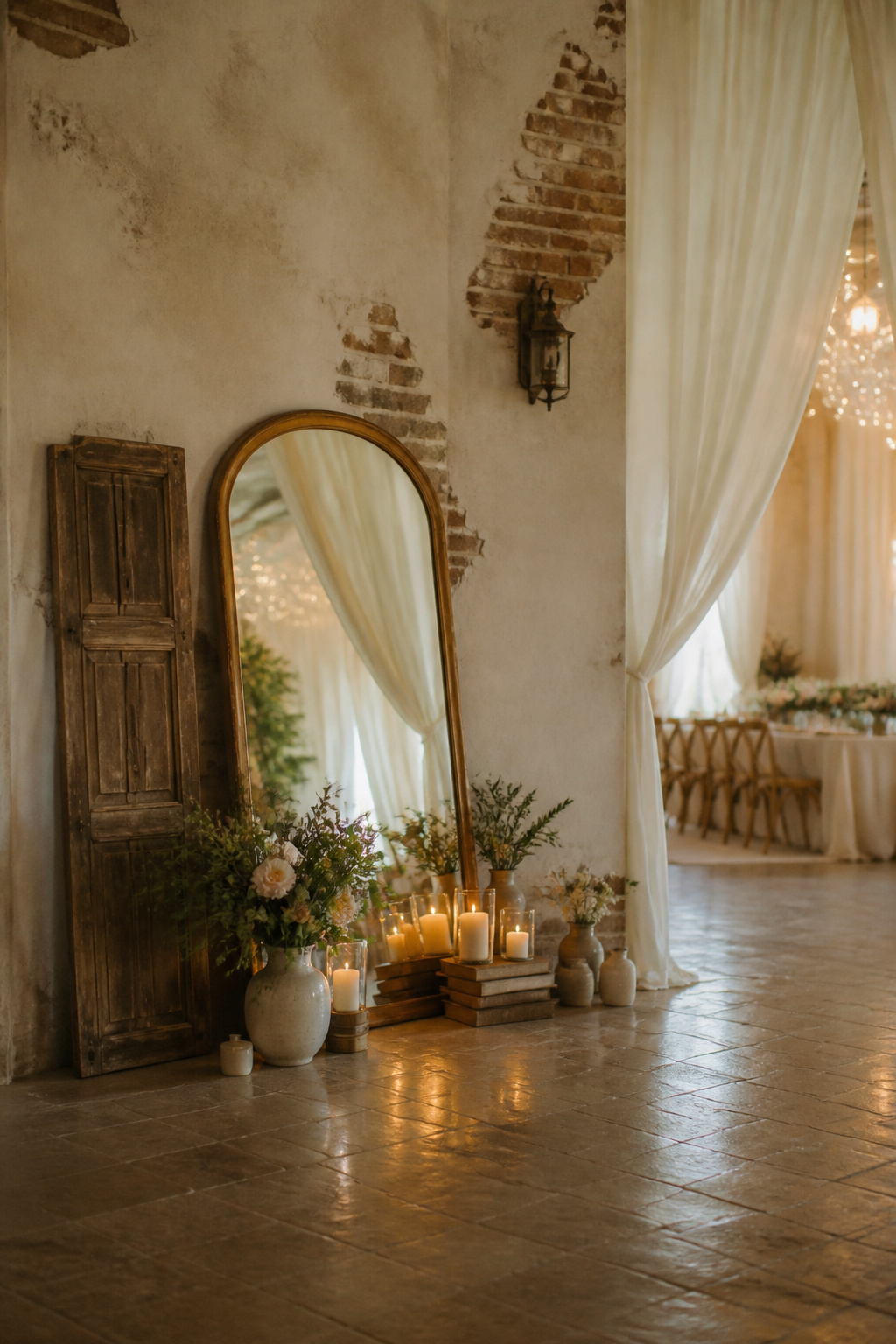
The line between intimate and lazy runs thinner than most couples realize when they start hauling their living room into a venue. A ceramic table lamp with a linen shade reads warm and collected; the same lamp missing its shade or still dusted from the bedside table reads like you forgot to plan. What saves a household piece is context: pair it deliberately, not park it hopefully.
Mirrors work the same way. A gilt frame propped behind a cluster of thrifted candlesticks becomes architecture; that same mirror leaned against a folding table with its price sticker half-scraped off becomes a garage sale. The sources that pull this off treat the item as a beginning, not an ending: mismatched glass vases grouped by height, books stacked under a centerpiece to lift it into light, wooden lanterns marched down the aisle then rotated straight to guest tables. Repetition rescues the ordinary. One basket holding a flower girl’s petals is cute; three baskets reused for favors at the reception is a choice.
What reads lazy is the single object floating without purpose, the thing you grabbed because it was already in the car. The thrift store can supply the pieces, but the intention has to come from you: a color that repeats, a height that relates, a reason this object lives in this room tonight.
13. Christmas Lights or Fairy Lights

Fairy lights carry smaller bulbs set closer together than the larger globes people usually mean by "string lights." That tighter spacing matters when you are wrapping something narrow, a railing or a branch or the frame of a tent, because the light stays even instead of pooling in bright spots. The bulbs themselves are tiny enough to read as texture from a few feet away, not as individual points, which is why they work behind fabric or woven through greenery where larger bulbs would look clunky.
Where they fail is storage. The thin wire tangles on itself if you just stuff it in a bin, and the knots take patience you will not have the week before a wedding. What convinced me, reading through a dozen of these setups, is that the couples who kept their sanity wound each strand around a piece of cardboard or a mailing tube and secured the ends with masking tape. The ones who skipped that step spent an evening with a flashlight and sore fingers instead of doing something else.
14. Personalized Cocktail Napkins

Minimum order quantities start around 50 napkins on Etsy, which is manageable even for a guest list under a hundred. The trick is placement: stack them at the bar where hands are busy and eyes linger, or tuck one under each place setting so the custom print faces the chair. I ordered mine with just our initials and the date, nothing ornate, and the print quality held up fine against condensation rings. Skip the cocktail hour tables; guests grab and go there without noticing. The bar is where people pause, read, and comment. That small detail of seeing your names in someone else’s hand is what reads as intentional rather than leftover.
15. Ribbon and Bows

Ribbon is one of those materials that looks like you spent more than you did, which is exactly why it shows up in so many weddings I photograph. A spool of satin or grosgrain runs a few dollars and covers a lot of ground. I have seen it turn plain folding chairs into something intentional with a simple knot at the back, or close a ceremony program with a tie that guests actually notice. Bouquet wraps are another place where ribbon earns its keep: a wide strip wound tight around stems hides the mechanics and gives the florist’s work a finished edge.
The mistake I keep seeing is ribbon used on anything that already has its own visual weight. A tablecloth with a thick satin border, then a ribbon layered on top, starts to look like craft-store clutter rather than simple decor. The same material that elevates a plain chair back cheapens an already-busy surface. One layer of something is usually enough.
16. Floral Wedding Arches
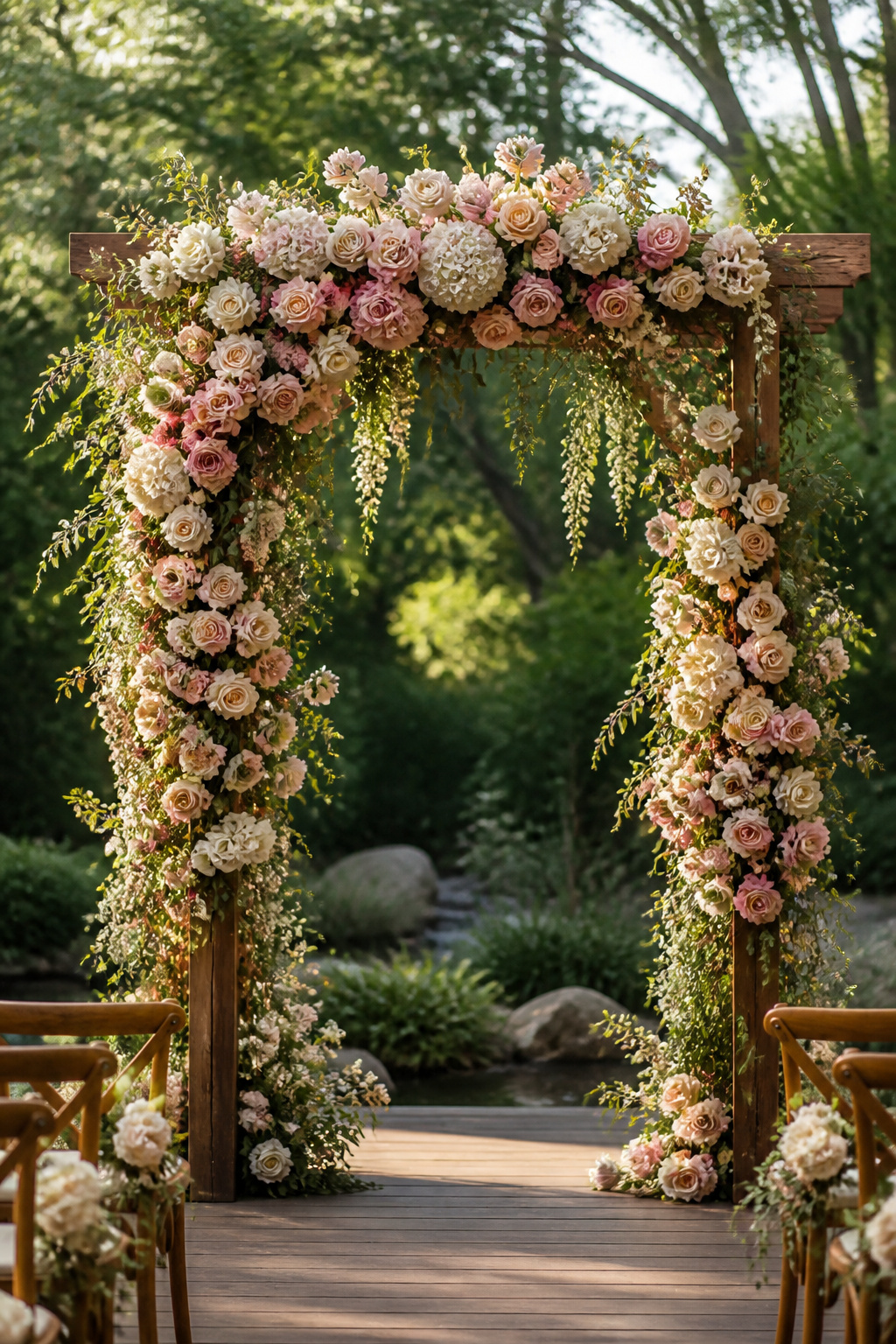
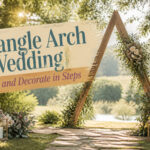
A floral arch frames the moment everyone photographs, and the frame itself matters more than I expected. Wood, pipes, or tubing each carry different loads. Wood looks warm in outdoor light but needs real joinery or it wobbles. Galvanized pipe is rigid and rents clean, though the fittings show if your flowers do not cover them fully. Tubing bends into circles or asymmetrical shapes, which is where the trend has moved, but it twists under wind unless you stake it deep.
What I underestimated was the weight once the flowers go on. A bare metal frame one person can lift becomes something else after you tie in hydration cages, foam, and stems. Build versus rent splits on this. Building from pipe or tubing at a hardware store runs cheap if you own a pipe cutter and a truck to haul it. Renting skips the math of whether your joints hold and who breaks it down at 10 p.m. Most rental houses here deliver arch frames with sandbag bases included, which is the detail that would have saved my shoulders.
The sources agree on assembly: glue, tie, or wrap flowers at varied sizes across the frame. Premade frames come from hardware or home goods stores online. Balloons, fairy lights, or curtains layer on after the greenery is secure. The move that reads intentional is keeping the color palette tight, three tones at most, so the arch photographs as a shape rather than a pile of color.
17. Eco Confetti

Dried lavender, rose petals, or punched leaf cutouts make confetti that the ground absorbs instead of the venue staff. The cleanup advantage is real: no plastic sweep-up, no rental fine for missed bits in the grass. I saw this go sideways once at an outdoor summer wedding in Maryland. The couple had filled kraft packets with dried delphinium the night before, and morning dew had crept in through the loose folds. By the toss, the petals had softened into damp clumps that fell straight down and stained the bride’s mother’s linen sleeve.
If you’re setting this out yourself, seal the packets tight and keep them under cover until the last minute. A confetti bar with open jars looks inviting in photos, but guests grazing through the mix with damp hands only speeds the problem. Pre-made packets double as place cards or table accents, which solves the display question and keeps the contents dry until the moment actually arrives.
18. Kids-Only Corner

Parents usually picture a quiet table with crayons and a coloring book. The kids picture anything but. What actually keeps younger guests occupied is a space adults are not allowed to enter, even briefly, because the moment a parent drifts over to check in, the spell breaks and half the table follows them back to the grownup chairs.
Set up a separate area with treats, activities, and seating sized for small bodies. Buy supplies beforehand and arrange them the day of; almost no prep is required. Individual kits at each place make kids feel the space belongs to them, not that they have been deposited at a leftover table. The treats matter more than the activities, honestly. Sugar buys twenty minutes of stillness that no craft project matches.
What goes in the kits depends on the age spread. A five-year-old and a ten-year-old share almost no interests, so plan for overlap or split the corner into two zones. Either way works, but mixing them without a plan guarantees the older kids wander and the younger ones get intimidated.
Parents will thank you. More importantly, they will stay in conversation longer than they expected, because the children do not keep circling back to the main tables.
19. Floating Candles

A clear bowl, water, and a tealight are all it takes, which is exactly why this works for a budget wedding. I set these up for a spring reception and learned two things fast. The wick has to stay centered or the flame burns against the glass and leaves soot marks in a straight line. A dab of wax on the bottom of the tealight fixes it to the bowl floor, though then it is not technically floating anymore. That trade-off is yours.
The real problem was the bowls themselves. The dollar-store glass looked fine on the shelf, but the rim warped just enough that water climbed the edge by surface tension and left a ring on the linen. Thicker glass bowls from a restaurant-supply store solved it for maybe two dollars more per piece. No marbles, no dyed water, no flowers crowding the surface. The plain version reads as intentional because the pieces are clean.
20. Keepsake Jars
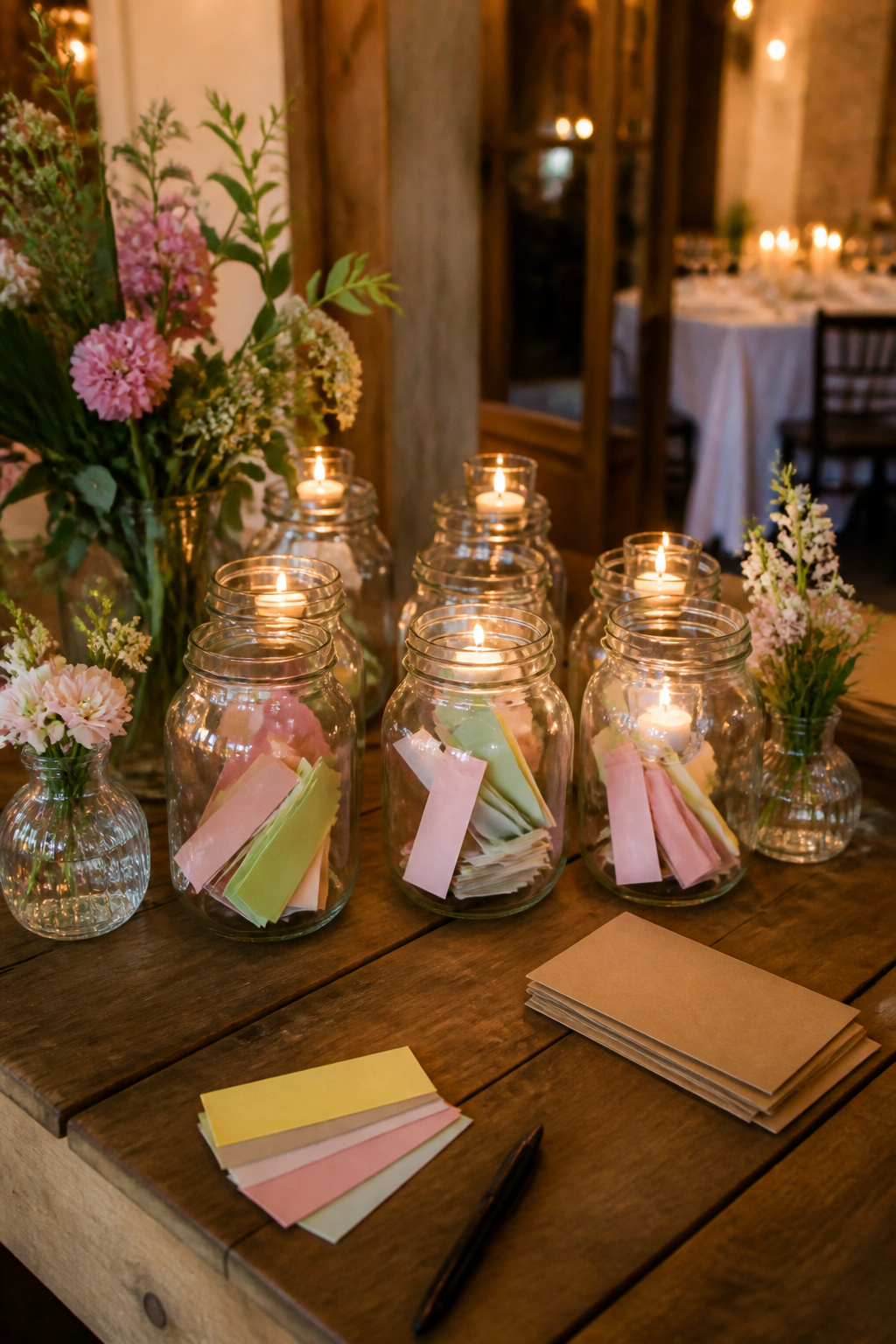
Simple decor for wedding receptions often doubles as something guests take home, and keepsake jars land in that space between decoration and favor. Label a set of clean mason jars or small glass containers, set them on a table with a pen and a stack of paper strips, and guests write notes or wishes while the evening unfolds. The jars themselves become part of the tablescape until they are full.
For a beach wedding, guests fill the jars with sand and shells collected from the shore. No beach nearby? Fill them beforehand with candy, mints, seeds to plant later, or glitter that matches your palette. The upfront work is just the labeling, unless you buy them pre-printed. What you collect inside shifts the tone: handwritten messages read intimate, while seeds or candy lean playful. Either way, the couple leaves with physical evidence of who was there, which beats a traditional guestbook that stays on a shelf.
21. Flip-Flop Station
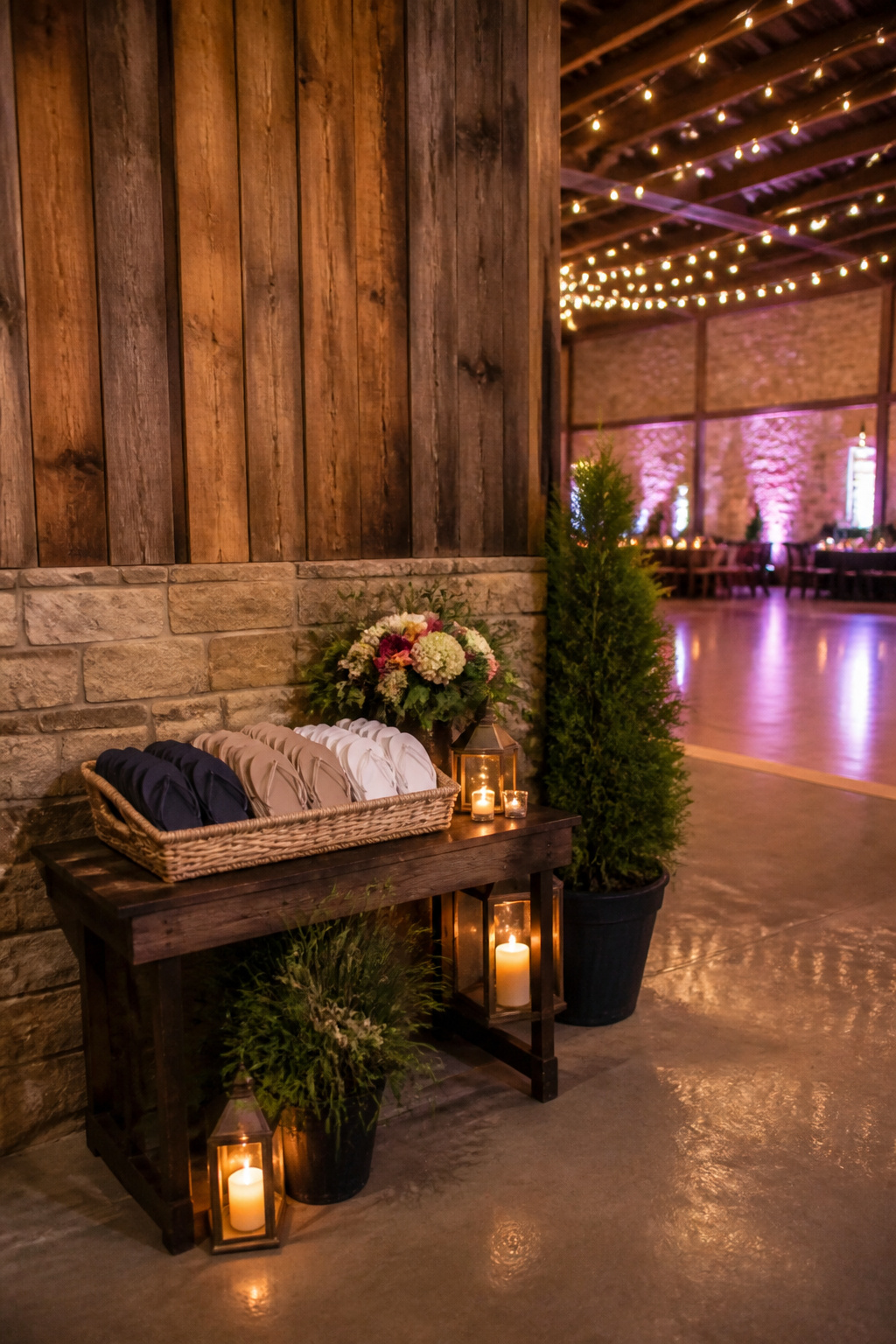
A basket of flip-flops by the dance floor looks like a kindness until someone kicks one under a chair and a guest in heels trips over it. I learned that the hard way at a summer reception where the size range stopped at women’s 10, and three guests stood there barefoot anyway, holding sandals that cut into their heels. The fix is obvious after the fact: run the range up to at least a men’s 12, or label the basket "up to women’s 10" so people know before they dig. Placement matters more than the display itself. Tuck the station against a wall, not at the edge of the dance floor where stray pairs migrate into traffic, and use a shallow bin rather than a deep basket so the sizes stay visible without a guest having to crouch and sort. The whole point is keeping people on the floor, not creating a new obstacle to step around.
22. Bug Spray and Sunscreen Station
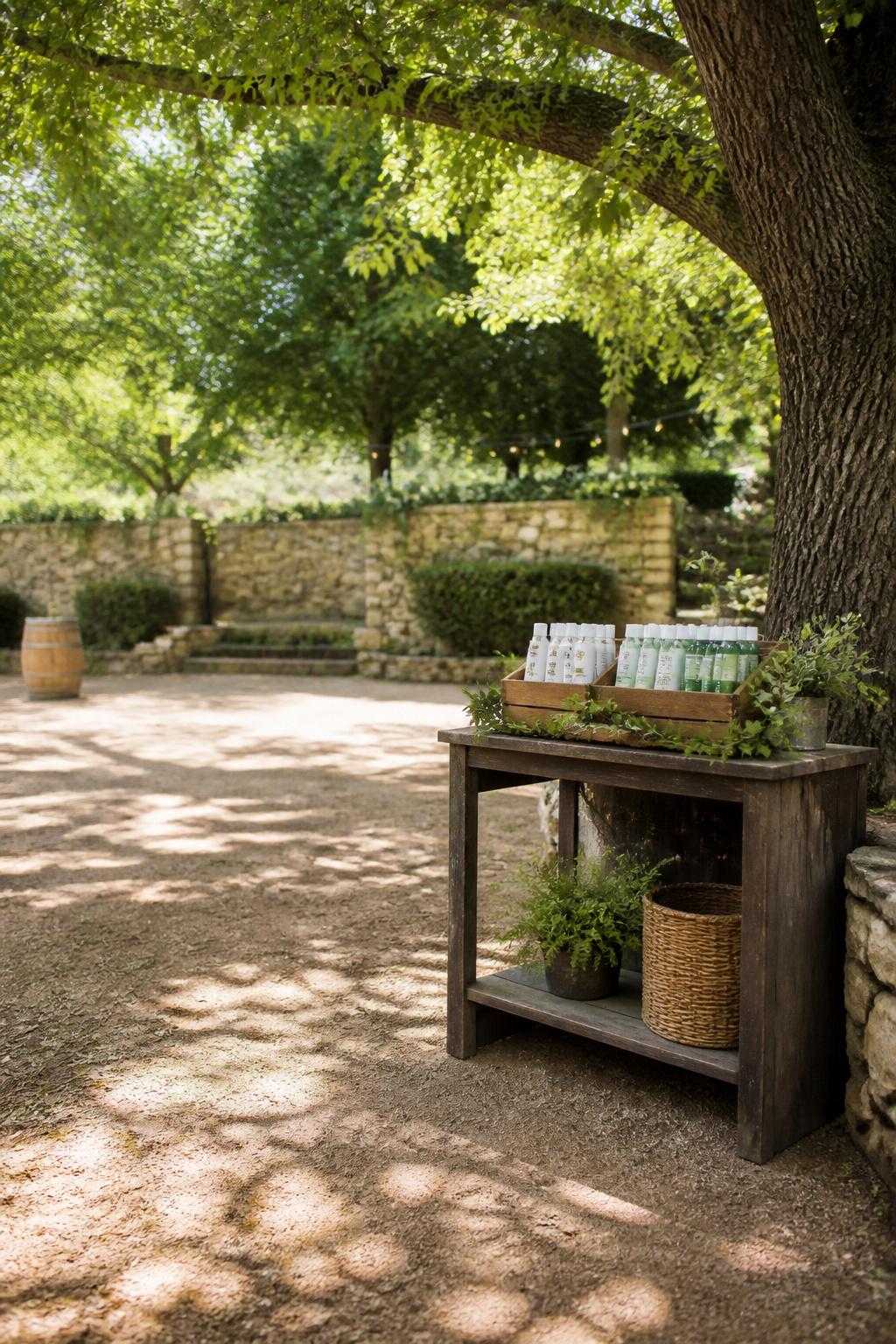
Outdoor weddings in July have a way of reminding guests that nature was not invited. The couple who thinks ahead sets out bug spray and sunscreen in labeled bottles, not the store-brand cans they grabbed on the way to the venue. Labels matter more than you would guess. At a ranch wedding outside Austin I photographed, the station was a galvanized bucket with three identical pump bottles marked "SPF 30" and "Deet-Free Repellent." Clean, legible, and the bride had filled them the night before from bulk containers she ordered online. The guests used them.
The bad version was at a lakeside ceremony two months later. The couple left the original OFF! and Coppertone packaging out on a folding table. Photographers notice these things because guests linger there, reading labels instead of joining the dance floor. The branding clashed with every other detail the couple had chosen with care. Worse, half the cans were empty by cocktail hour, so the maid of honor made a run to a gas station and returned with neon bottles that photographed even worse.
A basket or bucket holds the bottles. Labels facing forward. Refill before the reception starts.
23. Marriage Building Blocks

A guest-book table with wooden blocks and markers looks like an activity guests will linger over, but most of the writing happens in the cocktail hour lull before anyone has had wine enough to get creative. The blocks themselves are easy enough to make: buy a set, paint or stain them if you want, leave one face bare for Sharpie tips. Set out fine-point markers, not the chisel kind, or the letters bleed and half the advice becomes unreadable by morning.
Stacking the blocks into some kind of sculpture at the end of the night rarely happens. The couple usually ends up with a sack of loose timber and handwriting they now feel obligated to keep. A friend of mine stored hers in the garage for two years before admitting no one had ever played Jenga with marriage advice on the pieces, and she did not know what else to do with them. The format works better if you genuinely want the object, not the sentiment; if you do, build a simple box to corral them so they read as a keepsake rather than clutter.
24. Date Suggestion Jar
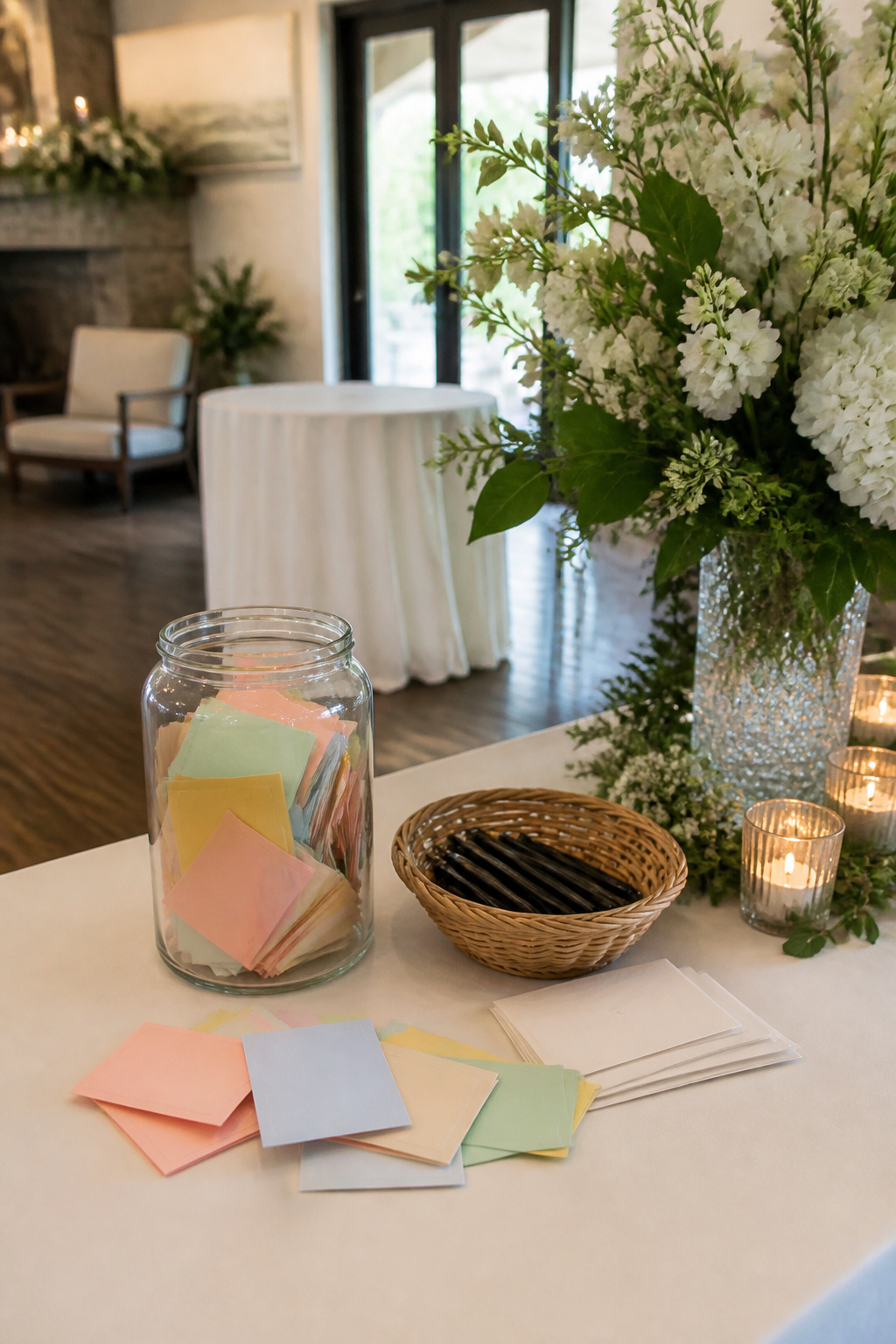
A date suggestion jar sounds sweet until you sort through it afterward and find half the slips say "dinner and a movie." The clustering happens fast; guests reach for the obvious when they are put on the spot.
Set out small cards instead of loose paper, and add a one-line prompt: an activity under $20, something outdoors, a date that takes under an hour. The prompt shapes what you get back far more than the jar itself ever will. A second jar labeled "duplicates go here" keeps the main collection readable, or you can ask guests to initial their suggestion so repeats are easy to spot and merge.
The jar itself is zero craft. Any glass or ceramic container works, and a simple label in your handwriting ties it to the rest of the table. Provide pens that actually write; the cheap ones at rental venues skip, and guests give up.
25. Hula Chandelier

The hula-hoop chandelier sounds like the easiest win on the list. Wrap a hula-hoop in fairy lights, hang it, done. The hanging hardware is where this project fights back.
I assumed ceiling hooks and fishing line would handle it. They do not, not cleanly. A standard hula-hoop is light but wide, so it spins and tilts the moment the lights are uneven. You need at least three anchor points, spaced in a triangle, to keep it level. Fishing line cuts into ceiling tiles or drywall over time; braided picture wire and proper swag hooks are worth the extra trip.
For the lights themselves, battery-operated strands keep you free of wall outlets. The sources recommend letting some lights drape below the hoop rather than wrapping every inch. That draping is what reads as chandelier rather than just a lit circle. LED fairy lights stay cool, which matters when the thing hangs low enough for guests to walk under.
Size is the judgment call. The original suggestion says go big if you want impact, and that is correct, but a 36-inch hoop at standard ceiling height feels like a obstacle. For an eight-foot ceiling, stick to 24 inches. Higher ceilings can take the larger size because the perspective changes. Hang it over the dance floor, not the dinner tables, where people are standing and the movement makes the lights flicker and sway.
26. Flower Wall
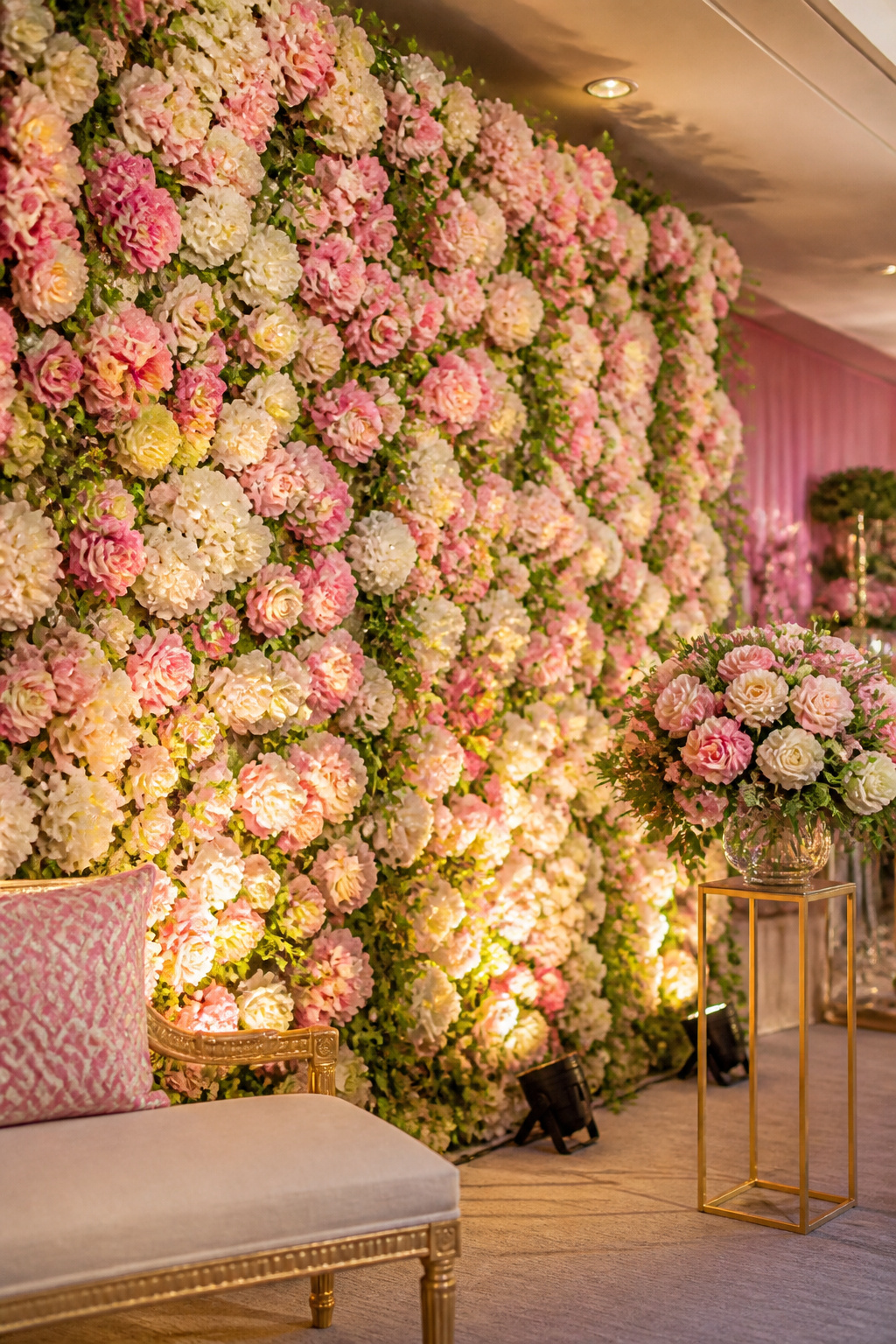
A dense floral panel reads as luxury in photos in a way scattered centerpieces never quite manage. The trade is time, and the posts that make flower walls look effortless rarely show the build.
Fresh blooms give depth, color variation, and that slight droop by evening that photographs as romance. The cost climbs fast, and so does the labor: someone has to hydrate, transport, and pin hundreds of stems the morning of, then strip the wall before wilt sets in. Artificial panels skip that scramble. Modern silk and latex flowers hold their shape under flash, need no water source, and ship back in a box when the night ends. The catch is flatness. Up close, even good fakes read as craft store; from ten feet back with a shallow depth of field, the camera rarely tells.
For a simple decor for wedding budget, rent artificial panels and cluster a few fresh stems at eye level where guests actually stand. You get the photo impact without the crew. I have watched couples lose two hours of cocktail hour to stem-by-stem touch-ups they did not schedule. Build time is the hidden line item.
27. Table Runners

Burlap, linen, and paper each solve a different problem that cheesecloth creates. Burlap brings the same airy width but holds its shape without the droop that can look like a wrung-out rag by the end of the night. The trick is knowing when that structure helps and when it fights you. On farm tables with real grain and knots, burlap feels finished; on sleek rental tables with laminate tops, the same runner looks like you forgot the real tablecloth.
Linen sits at the opposite end of the same decision. Where burlap announces itself, linen just lies there and behaves, which is exactly what you want when the flowers or the candles are doing the talking. It costs more, but it photographs cleaner and you can use it again.
Paper runners are the ones most people get wrong. The kraft roll from the hardware store reads as craft-project unless you commit: either print it, stamp it, or tear the edge deliberately so the imperfection looks chosen. A straight factory edge on cheap paper looks like you ran out of fabric. That is the failure mode to avoid.
Simple decor for wedding tables works when the material matches the table underneath it, not just the vision in your head.
28. Table Numbers
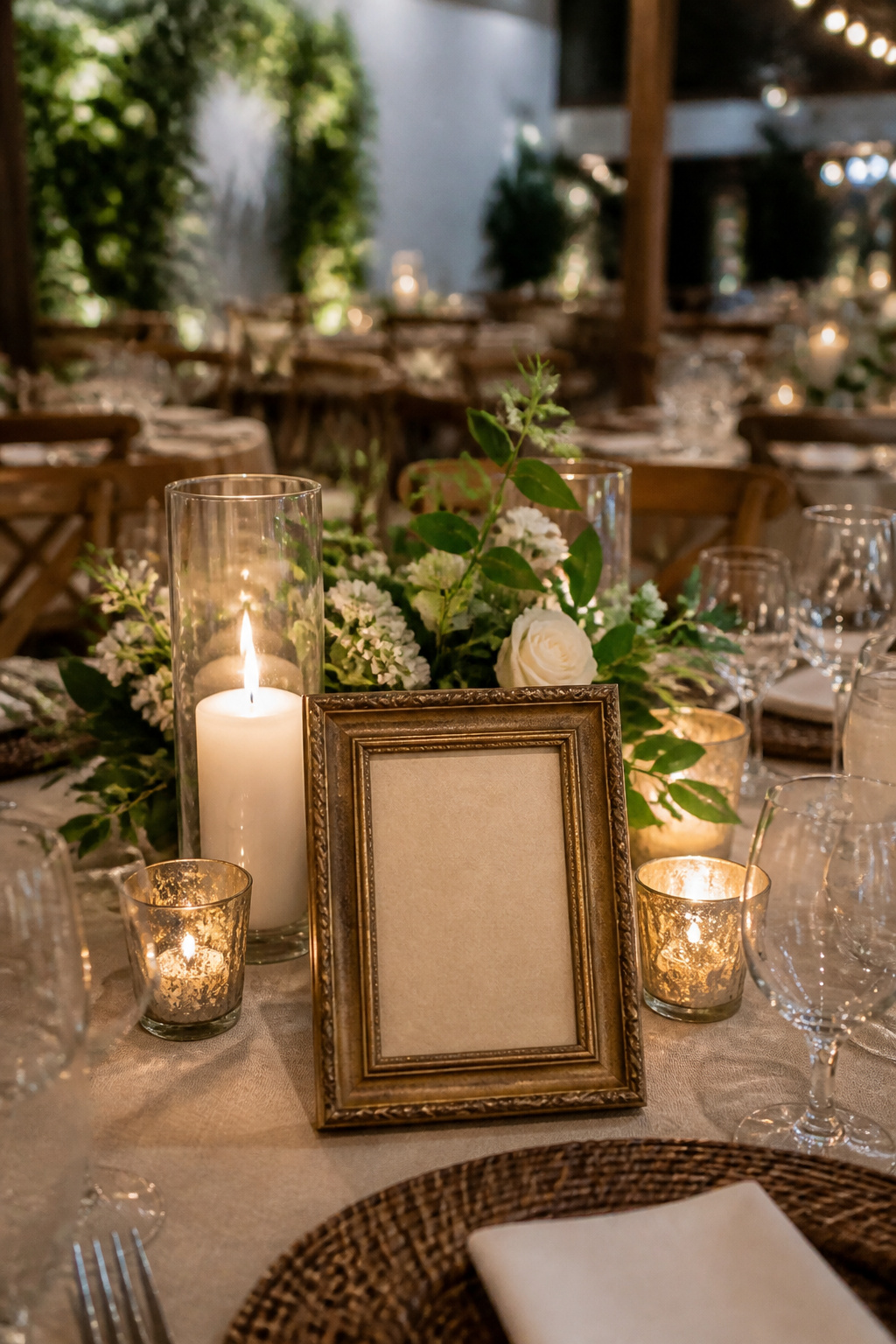
Table numbers sit right where every guest’s eyes land at least twice, yet small-budget weddings often skip them entirely or hand-write folded tent cards as an afterthought. That gap is the design opportunity: free printable table number templates let you hit a level of polish that reads as intentional without touching the floral budget.
The mistake I made at my cousin’s reception was picking a script font that looked beautiful on screen and illegible from three feet away. Guests stood in the aisle squinting, trying to decode whether they were at table six or table eight. A clean sans-serif or a serif with strong stroke contrast solves this; save the flourishes for the header or skip them.
Print on cardstock heavier than 110 lb or the stands tip. Standard 8.5 × 11 inch sheets trim cleanly to two numbers per page with a half-inch border, which means a pack of fifty sheets covers a twenty-five table room for under ten dollars. The templates that include a small icon, a line drawing of the venue, or the city skyline give guests something to remark on without adding bulk to the table.
29. Signage

Signs do more heavy lifting than most couples expect. At one wedding I photographed, the hand-lettered welcome board at the entrance set the whole tone before a single centerpiece was noticed, while three identical printed signs pointing guests toward parking kept traffic moving without anyone stopping to admire them. That split is worth planning for. The one sign every wedding forgets is the restroom directional, usually placed nowhere near where intoxicated guests in formal shoes actually need it.
Hand-lettered work wins on welcome boards and seating charts where guests linger; the slight irregularity photographs warmly and reads as intentional. Printed signs make sense for repeated directions or parking instructions where consistency matters more than charm. A simple wooden easel or classic white frame, like the ones rental stocks carry, handles either treatment without competing.
Seating instructions in particular suffer when couples get creative for creativity’s sake. A framed log slice or acrylic table number looks sharp, but guests need to find their names in under thirty seconds after two cocktails. Clarity is the decoration here. The same rental inventories that stock those wooden "Reserved" hanging signs and tabletop versions usually include straightforward frames in gold, silver, or natural wood that keep the message readable while still fitting the look.
If budget forces a choice, put the craft budget on the welcome sign guests photograph and the seating chart they study, and go plain printed for parking and restrooms. The ceremony arch and backdrop will dominate the photos anyway.
30. Decorative Candles or Lanterns
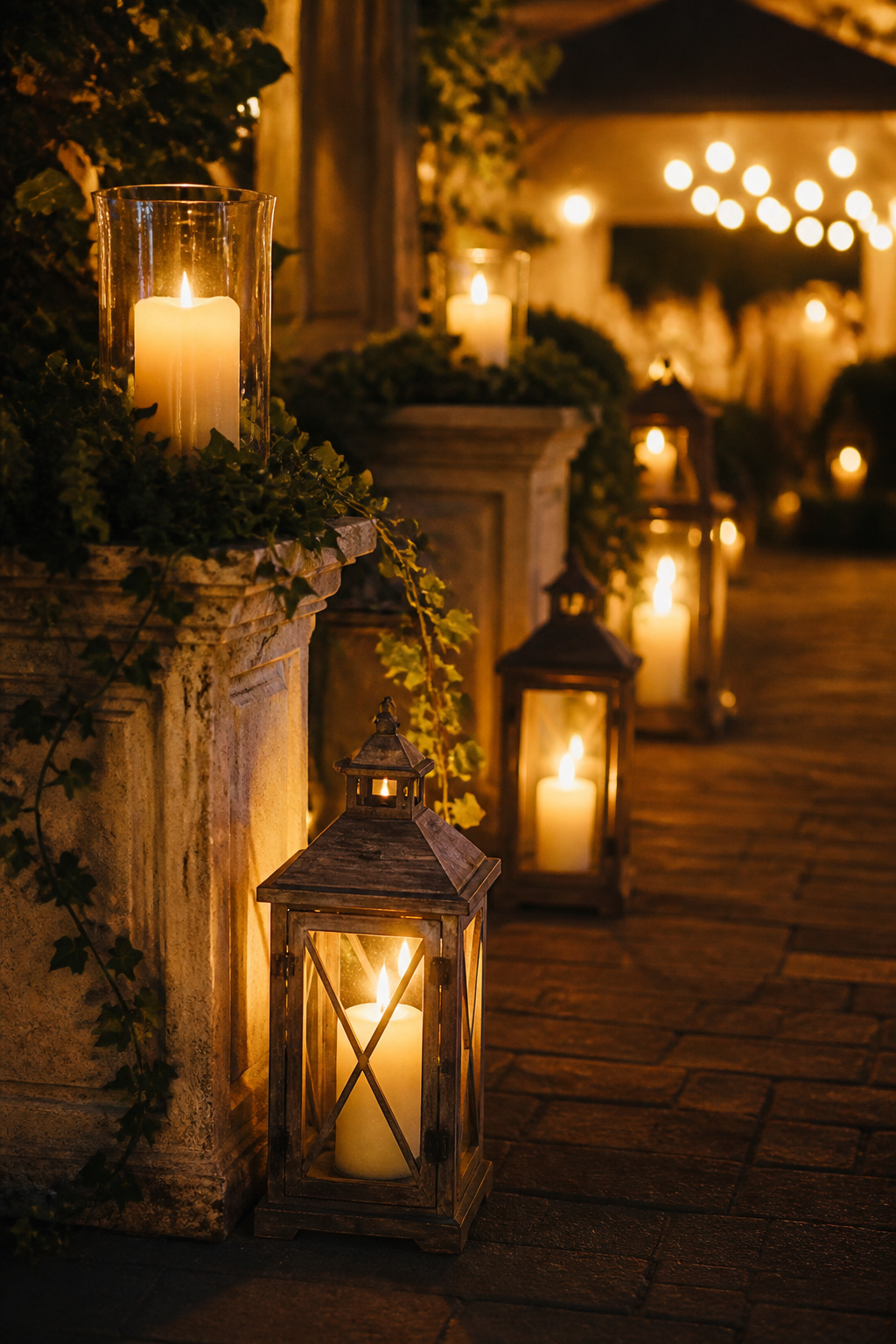
A cluster of pillar candles on a mantel or a row of lanterns along a garden path gives light that actually behaves like light, warm and uneven, rather than the flat blue of a phone screen. For outdoor receptions, citronella candles are worth the slight medicinal smell; guests remember the mosquito that bit them more than they remember the candle that didn’t. Wax drips are the real hazard with rented linens. A single pillar left to burn down to its base can leave a hardened pool that costs your deposit. Saucers or inexpensive glass bases solve this, and they read as intentional rather than apologetic. Battery-operated candles have improved to the point where guests standing more than arm’s length away cannot tell, which matters if your venue has a flame policy or if the wind picks up during the vows.
What Simple Wedding Decor Means
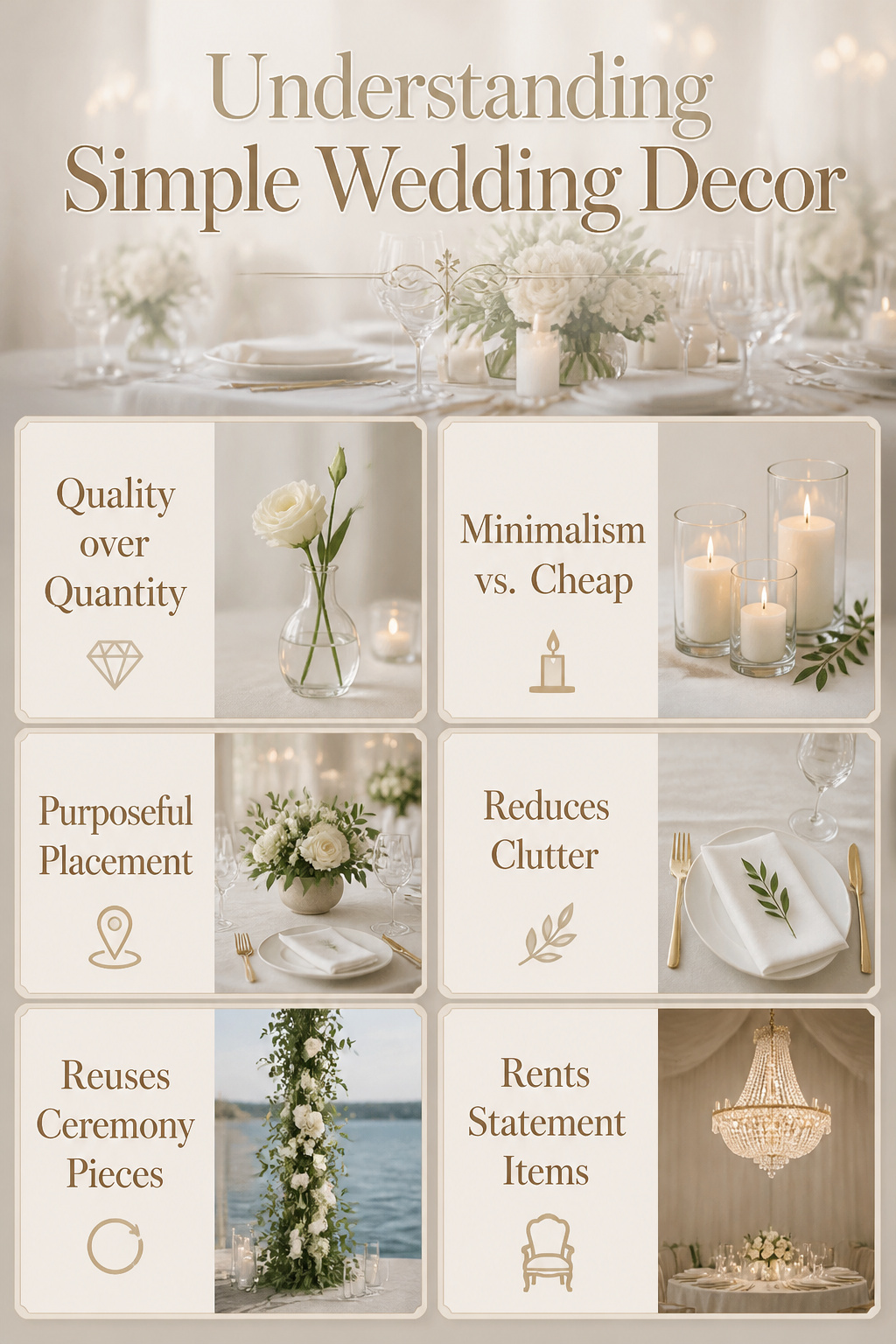
"Simple decor for wedding" means something different at every table I set up. One couple sees a single stem in a bud vase and calls it restrained; another calls the same thing unfinished. What the word actually points to, in most of the ceremonies I shoot, is intention over volume. The design quality matters more than how much of it fills the room.
This usually reads as minimalist, but minimal is not the same as cheap. A bold floral installation or a single dramatic light source can carry an entire reception space. The common thread is that every piece earns its place.
The list ahead stays in that territory: ideas that let the venue do some of the work, that reuse ceremony pieces for the reception, and that rent a few statement items rather than buying clutter. None of it requires large or expensive pieces to feel complete.
Making a Large Venue Feel Smaller
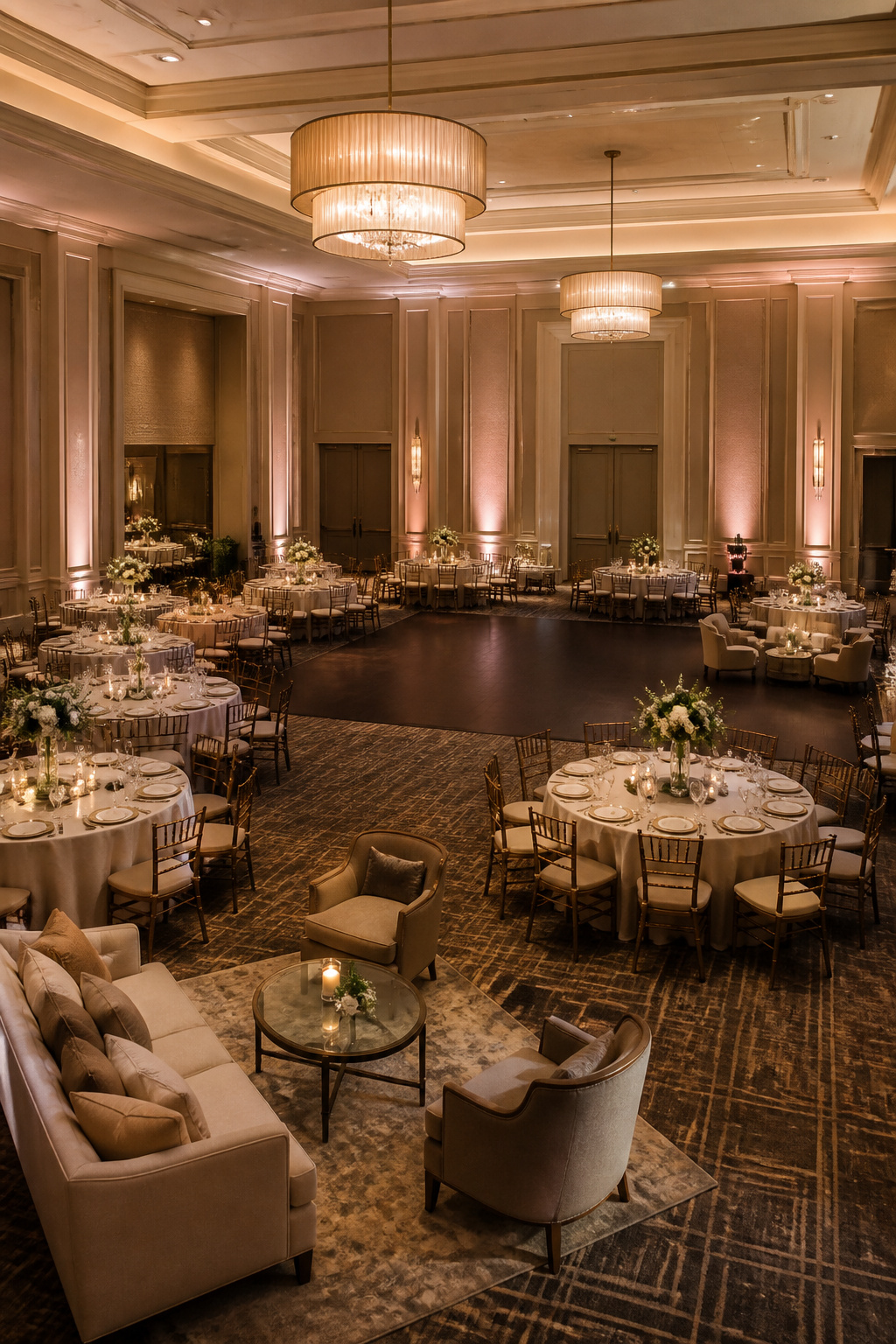
A ballroom with twenty-foot ceilings swallows couples whole if you let it stay open. Clustered seating breaks that swallowing effect faster than any draped fabric can. At a wedding I shot in downtown Portland, the planner pushed four ten-top rounds into a tight horseshoe with the dance floor nested inside. Guests walked through a narrow gap between tables to reach the bar, and the couple told me later that people danced who never dance, because the room suddenly felt like someone’s crowded living room.
Lighting does the same work from above. Warm uplighting at the perimeter draws the walls inward visually; string lights hung low over the tables compress the vertical space without a single ceiling drape. Tea lights down the center of each table add another layer of warmth that keeps eyes at table height, not drifting up to the rafters.
Defined zones finish the job. A separate lounge area with two sofas and a small rug near the cocktail space gives guests permission to settle instead of circulating through emptiness. The serpentine table arrangement Sonia and Hun used works on the same principle: one continuous curve reads as one intimate object, not furniture scattered across an acre of floor.
Impact Without Expense
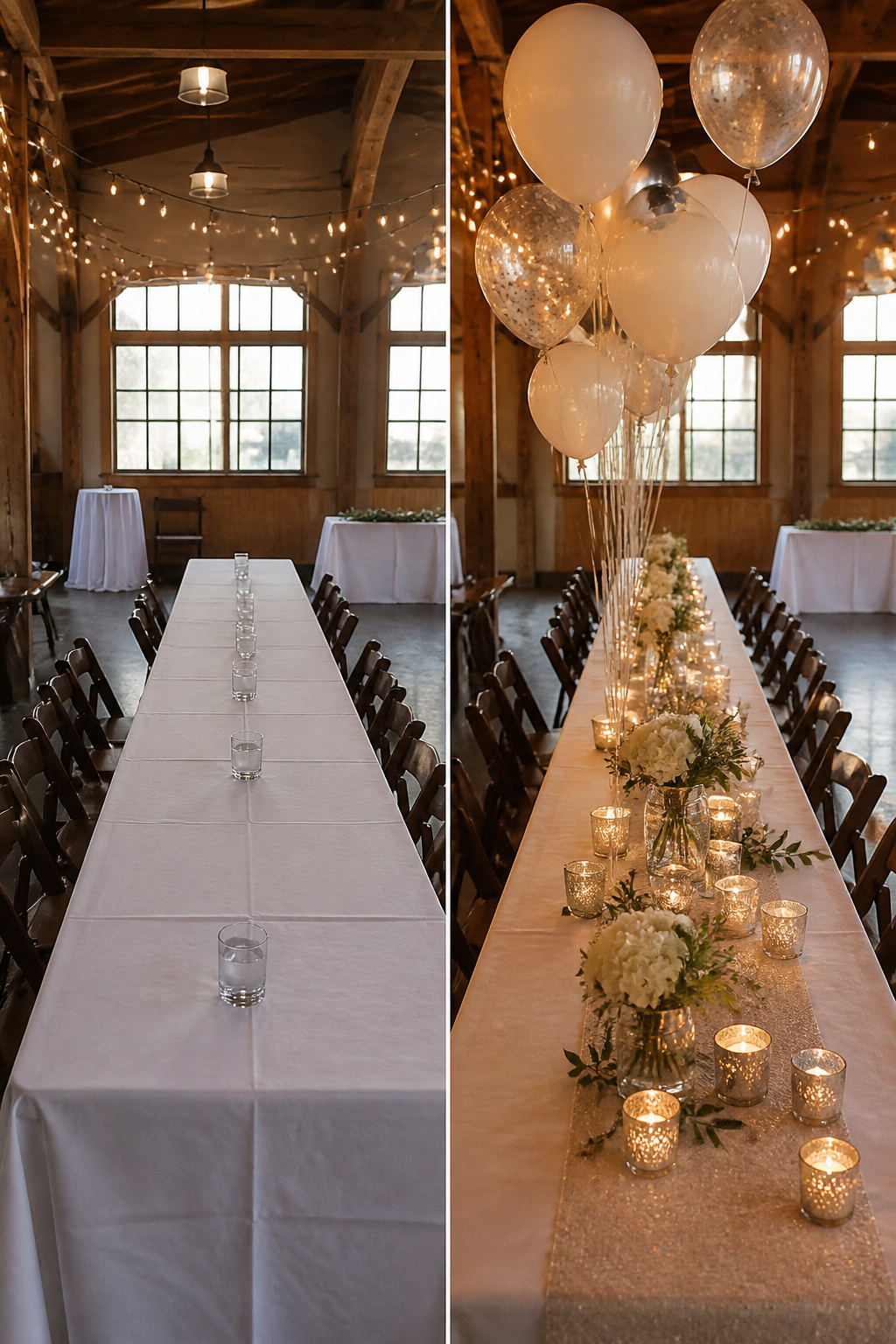
Simple does not mean small, and it certainly does not mean cheap. The most memorable weddings I have photographed lean on repetition, scale, and placement rather than price tags.
One couple I worked with rented fifty silver mercury votives and scattered them down every aisle, across the welcome table, and around the cake. The rental cost less than a single large floral arrangement, but the repetition made the whole room feel intentional. Another bride used balloons tied to aisle chairs in a venue with high ceilings; the vertical dimension filled the space without blocking anyone’s view of the ceremony.
Lighting works the same way. A single string of twinkle lights looks sparse. Thirty strands, wrapped consistently through overhead beams or draped behind the sweetheart table, reads as design rather than afterthought. Soft uplighting at floor level transforms a plain wall into warmth; candles on every guest table do what one centerpiece cannot.
The move that saves the most money is reusing ceremony decor for the reception. Those aisle candles come with you. The backdrop behind your vows becomes the photo booth background. Simple decor for wedding celebrations works when you buy or rent fewer things and use each one twice, or three times, in spots where guests will actually notice it.
Lighting as Ambiance
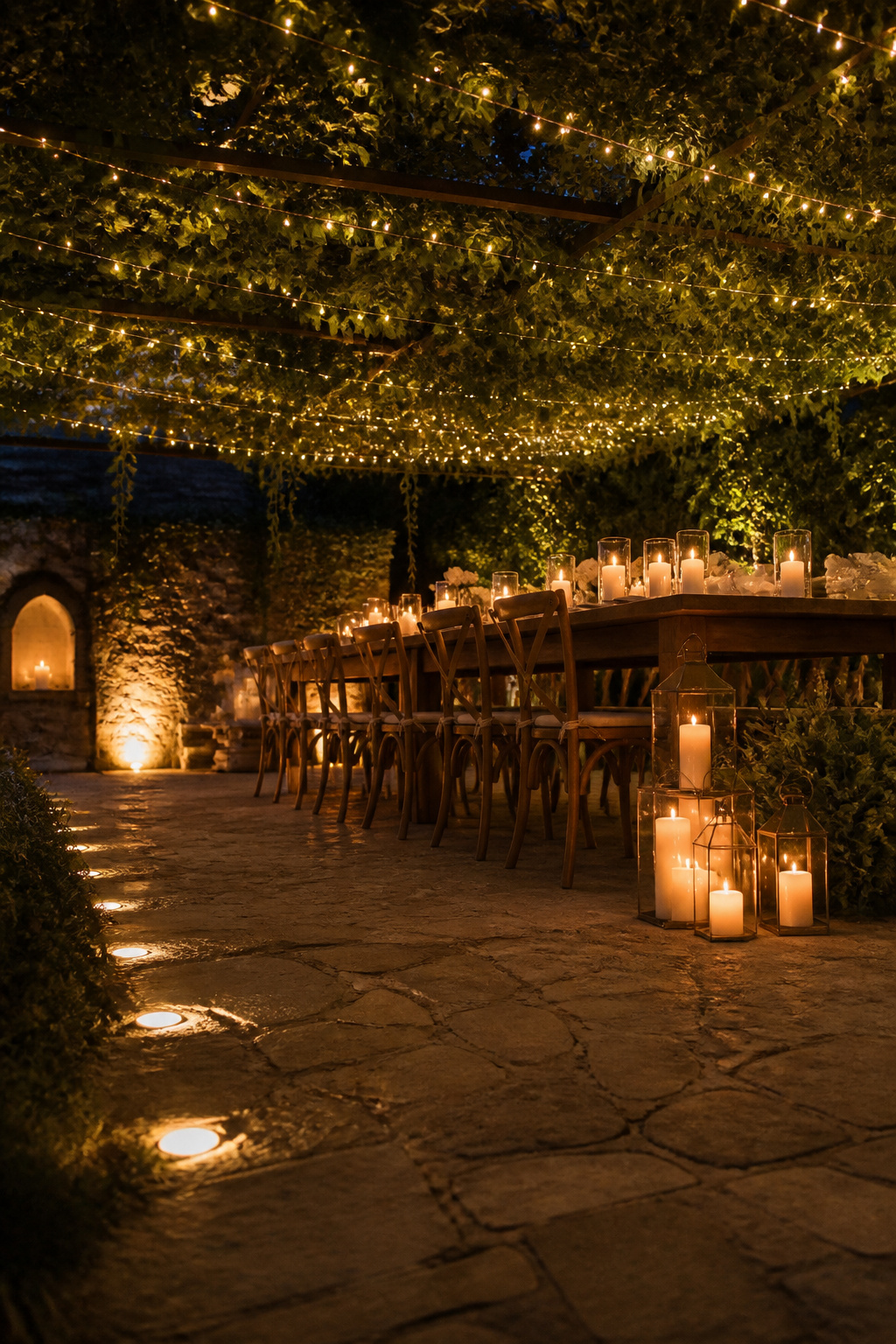
Twinkle lights and candles do the heavy lifting in simple decor for wedding spaces because they add warmth without adding clutter. Fairy lights stay cool even after hours of operation, which makes them safe around table linens and centerpieces where open flame might make a venue nervous. Candles work in every season and style, set down the aisle in lanterns or clustered on the welcome table with small floral accents.
The practical advantage is how little you need to transform a space. A big, open ballroom or a bare backyard both soften under strings of light. Buy after Christmas sales if your timeline allows, and the cost drops even lower. LED fairy lights draw minimal electricity, so extension cords and outlet hunting matter less than you’d expect.
I keep coming back to this pairing because it fails gracefully. A few votives still flicker if the battery pack on the lights dies. The strings still glow if a breeze snuffs half the candles. Neither demands a particular season, and neither fights the venue you already booked.
Personalization That Reads as Intentional

Borrowed family wedding portraits read as heritage, not clutter, when you keep the frames uniform and the placement sparse. Three or four grouped on a single table, all in thrifted gold or all stripped bare wood, give guests something to linger over without turning the room into a gallery. The photos themselves cost nothing if your parents or grandparents already have them framed.
Custom napkins sit at the opposite end of effort. Ordering them with a monogram or date is affordable, but the detail disappears in a pile on the bar. Stack a small count at the cocktail station itself, where people actually pause and notice, and skip them at the dinner tables where plates and glasses already compete for space.
A globe guestbook works for the same reason the portraits do: it is one object doing one job. Guests sign it as they arrive, and afterward it lives on a shelf instead of in a box. The white paint keeps it from reading as dorm-room decor. One guestbook alternative, placed where traffic naturally slows, beats three personalized items fighting for attention on the same surface.
Frequently Asked Questions
What is simple wedding decor?
Simple wedding decor depends on the couple’s own eye and priorities. For some it means cheesecloth runners and bud vases with a stem or two, for others it is thrifted frames and borrowed candlesticks. The common thread is intention: each piece earns its place rather than filling space by default.
How can I use simple decor to make a larger venue feel smaller?
Strategic layout choices warm up a big room faster than extra decoration. Serpentine or clustered tables break up open floor, warmer bulbs push walls back visually, and focused lighting draws guests inward. Repeating a single material, like brass candlesticks or wood lanterns across several tables, also tightens the feel without adding clutter.
Does simple wedding decor have to include larger or more expensive items?
Not at all. Impact comes from how pieces relate, not their price. Let the venue’s own architecture do some work, rent one or two statement pieces rather than many, and move ceremony decor straight to the reception. A bold fabric backdrop made from thrifted tablecloths and PVC costs little and still photographs like a custom rental.